

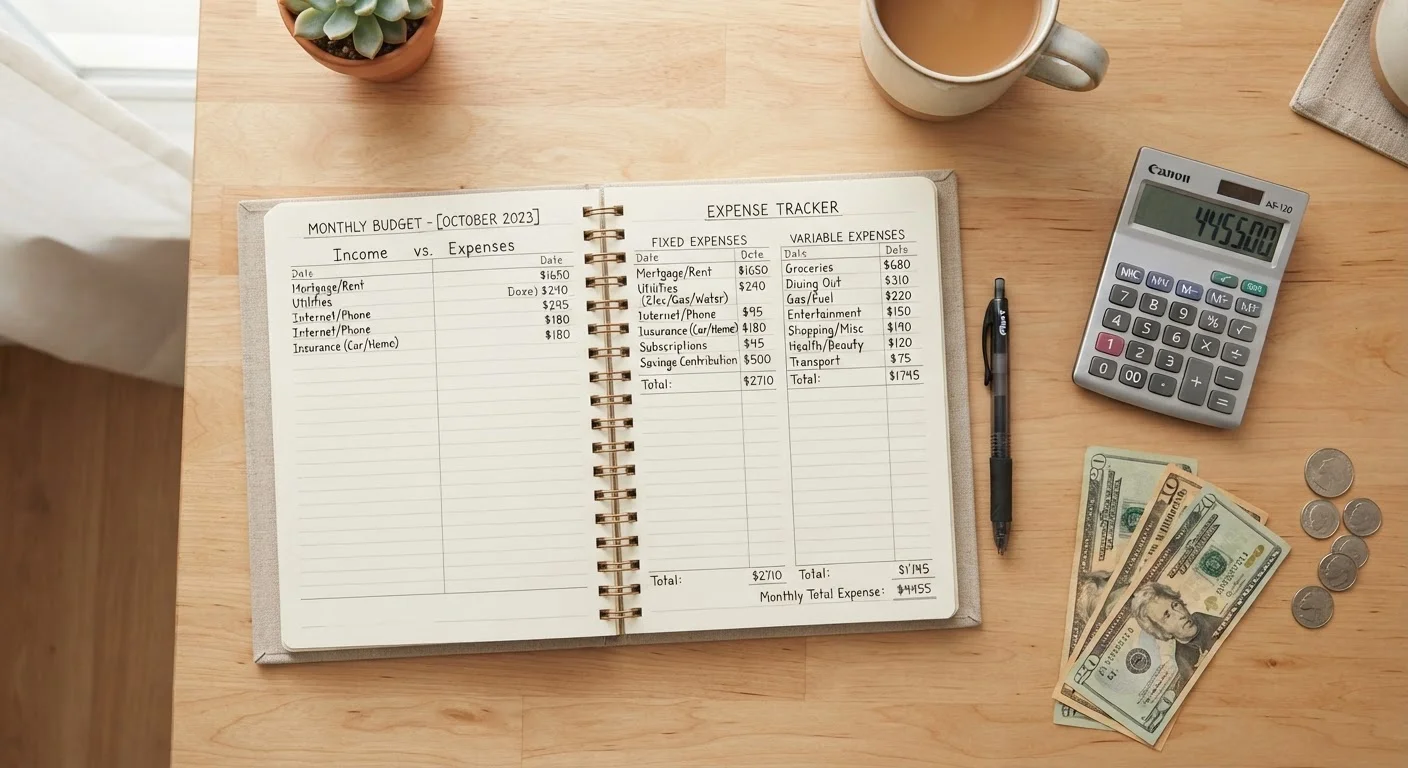
Option A
Fixed Expenses
The predictable, non-negotiable baseline of your budget.
Best for: Establishing a reliable spending floor that you can plan around every month without guesswork.
Option B
Variable Expenses
The flexible, adjustable portion of your spending.
Best for: Identifying where you have real spending choices - and where budget trims are actually possible.
What Makes an Expense Fixed or Variable
The simplest way to tell them apart: a fixed expense costs you the same amount every billing period, regardless of how much you use or do. A variable expense changes - sometimes predictably, sometimes not - based on your behavior, consumption, or circumstances.
Common fixed expenses include rent or mortgage payments, car loan payments, subscription services at a flat monthly rate, and most insurance premiums. You owe the same dollar amount each month whether you had a busy month or a quiet one.
Variable expenses include groceries, gasoline, dining out, clothing, entertainment, and utility bills. These shift based on usage and choices. A hot summer month could push your electric bill significantly higher; a week of cooking at home will pull your restaurant spending down.
It's worth noting that some expenses sit in a middle ground. Utilities, for example, recur every month but aren't fixed - your bill varies with usage. These are sometimes called variable recurring expenses, and they deserve their own treatment in a budget rather than being lumped into either pure category.
| Criterion | Fixed Expenses | Variable Expenses |
|---|---|---|
| Amount each month | Stays the same | Changes based on usage or behavior |
| Examples | Rent, loan payments, flat-rate subscriptions | Groceries, gas, dining, utilities |
| Predictability | High - easy to plan around | Low to moderate - requires estimation |
| In-month flexibility | Very limited | High - adjustable with behavior changes |
| Where to look for savings | Renegotiate, refinance, or cancel | Reduce usage or frequency |
| Budgeting approach | List exact amounts; review periodically | Average past spending; add a buffer |
Why This Distinction Changes How You Budget
Treating all expenses the same way is one of the most common budgeting mistakes. Fixed and variable costs require different planning tactics - not because one matters more than the other, but because they respond to different actions.
With fixed expenses, your main lever is negotiation or elimination. You can call your insurance provider to review your coverage, refinance a loan to lower a payment, or cancel a subscription you no longer use. But in a given month, you mostly can't change what you owe. That stability is useful for planning but leaves little room to maneuver when money is tight.
Variable expenses, by contrast, are where real in-month flexibility lives. If you need to free up $200 this month, you're unlikely to reduce your rent. But you can cook at home more, delay a non-essential purchase, or cut back on entertainment spending. This is why a flexible budget that accounts for variable costs is far more resilient than one that treats every line item the same way.
People also tend to underestimate their variable spending. Fixed costs are easy to list - they show up on autopay and rarely surprise you. Variable costs are diffuse and easy to overlook until you tally a month's worth of small purchases and wonder where the money went. This is precisely why zero-based budgeting approaches often force people to confront variable spending they had been ignoring.
Practical Tips for Each Category
For fixed expenses, the goal is accuracy and periodic review. List every recurring obligation and confirm the exact amount. Set a calendar reminder once or twice a year to review whether any fixed cost can be reduced - insurance policies, loan terms, and subscription rates do change over time.
For variable expenses, the goal is realistic estimation with a built-in buffer. Look at two or three months of past spending in each category and use an average as your baseline. Don't aim for an idealized number; aim for a realistic one. Then build a small buffer - typically 10-15% above your average - to absorb higher-than-usual months without blowing the budget entirely.
If your income is irregular, this distinction becomes even more critical. In lower-income months, variable expenses become the primary adjustment tool. Budgeting on a variable income works best when you've already identified which costs are locked in and which ones you can scale back without consequence.
It also helps to keep the broader spending picture in mind. The fixed vs. variable framework works alongside - not instead of - other ways of categorizing spending. Sorting costs into needs, wants, and savings adds another useful layer, since a variable expense can be either a genuine need (groceries) or a want (takeout every night).
This article is for general informational purposes only and does not constitute personalized financial advice. Consider consulting a qualified financial professional for guidance specific to your situation.
The content on this site is for informational purposes only and is not a substitute for professional advice. Always consult a qualified professional for guidance specific to your situation.