

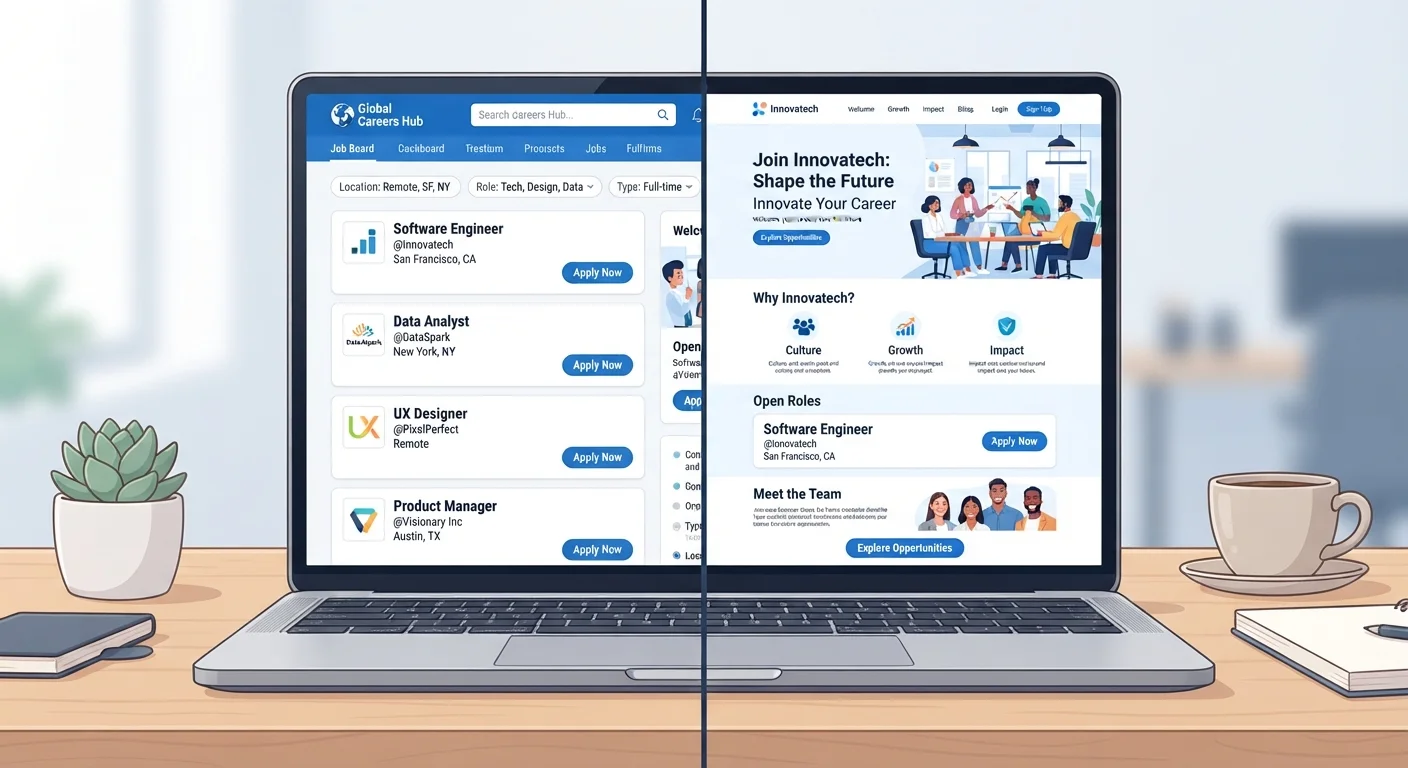
Option A
Job Boards (e.g., Indeed, LinkedIn)
The broad-reach, high-visibility search hub.
Best for: Job seekers who want to survey a wide market quickly and discover roles across many employers at once.
Option B
Company Career Pages
The direct, targeted application channel.
Best for: Job seekers who have specific employers in mind and want to apply straight to the source.
How Each Channel Actually Works
Job boards like Indeed, LinkedIn, and Glassdoor function as aggregators — they pull listings from employer sites, staffing agencies, and direct postings into one searchable database. That convenience is genuinely useful when you're trying to understand what roles exist in your field or region. However, the listing you see on a job board may be days old, already filled, or slightly different from the version on the employer's own site.
Company career pages, by contrast, are maintained directly by the employer's HR or recruiting team. When a position is open, it appears there first. When it's filled, it comes down immediately. There's no middleman, which means the information you're reading — responsibilities, qualifications, salary ranges if disclosed — is current and authoritative.
Understanding this distinction helps you decide not just where to apply, but how to prioritize your time. As part of a broader strategy, see the end-to-end job search roadmap for how this fits into every stage of a search.
Head-to-Head: Key Differences That Matter
The table below captures the practical trade-offs that affect your day-to-day search experience.
| Criterion | Job Boards | Company Career Pages |
|---|---|---|
| Listing breadth | Thousands of roles across employers | Only that company's open roles |
| Listing freshness | Can lag hours or days behind | Updated in real time by employer |
| Exclusive roles | Often missing internal or niche roles | Full picture of all openings |
| Application competition | High — many applicants per post | Varies — often lower volume |
| ATS processing | Extra conversion step possible | Direct feed to employer ATS |
| Search efficiency | Fast — filter many employers at once | Slower — one employer at a time |
| Privacy control | Profile visible to many recruiters | Application is targeted and private |
| Company context | Limited employer detail in listing | Rich employer info alongside listing |
One factor worth highlighting: application tracking systems, or ATS (software employers use to manage incoming resumes), can behave differently depending on where you apply. Submitting through a job board sometimes routes your resume through an extra layer of formatting before it reaches the employer's system, which can occasionally strip formatting or metadata. Applying directly on the company's site usually feeds straight into their ATS with fewer conversion steps.
What Job Boards Do Well — and Where They Fall Short
Job boards excel at market discovery. If you're new to a field, re-entering the workforce, or simply unsure what roles match your skill set, browsing a job board gives you a fast, low-effort view of what's in demand. You can filter by location, salary, experience level, and job type in seconds.
They're also useful for researching salary benchmarks and understanding how employers describe roles — language that can sharpen your resume and interview answers. Tools like LinkedIn's job alerts mean relevant listings arrive in your inbox without daily manual searching.
The limitations are real, though. Popular listings on major job boards can attract hundreds of applicants within 24 hours. Your resume enters a crowded pool, and you have little visibility into how or when it's reviewed. Some postings are also duplicated, outdated, or posted by recruiters who are building pipelines rather than filling an immediate opening. This is part of why a high-volume spray approach tends to underperform — for more on that, see why applying to dozens of jobs at once often backfires.
~250
Average applicants per corporate job posting
Research from Greenhouse and similar recruiting platforms suggests popular job board listings routinely attract 200–300+ applicants per opening.
~30%
Jobs never publicly listed on job boards
Career researchers commonly estimate that a significant share of positions are filled through direct channels, referrals, or internal postings before reaching major boards.
What Company Career Pages Offer That Job Boards Don't
The most practical advantage of going direct: exclusive listings. Many employers, particularly mid-size and large organizations, post internal promotions and niche roles only on their own careers page — never on job boards. If you're targeting specific companies, checking their career pages weekly is the only way to catch those openings.
Applying directly also signals focus. Recruiters can see the source of your application, and a direct submission often implies you sought out the company intentionally rather than clicking a board result. That distinction matters less at large corporations with high applicant volume, but at smaller employers it can carry weight.
Company career pages also give you richer context about the organization — values statements, team pages, recent news — all useful for tailoring your application and preparing for interviews. Pair this research habit with a strong professional presence: what a strong LinkedIn profile actually looks like explains how recruiters evaluate candidates before they even open a resume.
If you're conducting your search while currently employed, direct applications also give you more discretion. Job board profiles can be visible to recruiters at your current company. For more on managing that risk, see job searching while employed.
When a Job Board Listing Points Directly to the Company Site
Many job board listings include a button labeled 'Apply on company site.' When you see this, click through and complete your application there rather than through the board's one-click system. This gives you the benefits of job board discovery while still routing your application through the employer's own ATS — the better of both options in most cases.
The Practical Strategy: Use Both, Intentionally
The most effective job seekers treat job boards and company career pages as complementary tools, not competing ones. A workable workflow looks like this:
- Use job boards to discover and research. Set up alerts for your target role and location. Use results to identify companies you hadn't considered and to gauge the market.
- Build a target employer list. From your research, identify 10–20 companies where you'd genuinely want to work.
- Apply directly through company career pages. For roles you're serious about, go to the employer's site, find the listing there, and submit through their official portal.
- Track everything. Note where you applied, through which channel, and on what date. This prevents duplicate submissions and helps you follow up appropriately.
This approach balances discovery with precision — the kind of focused effort that tends to produce better results than casting the widest possible net. It also connects to broader thinking about long-term career growth, since the employers you target now may become part of your professional network for years ahead.
The content on this site is for informational purposes only and is not a substitute for professional advice. Always consult a qualified professional for guidance specific to your situation.