

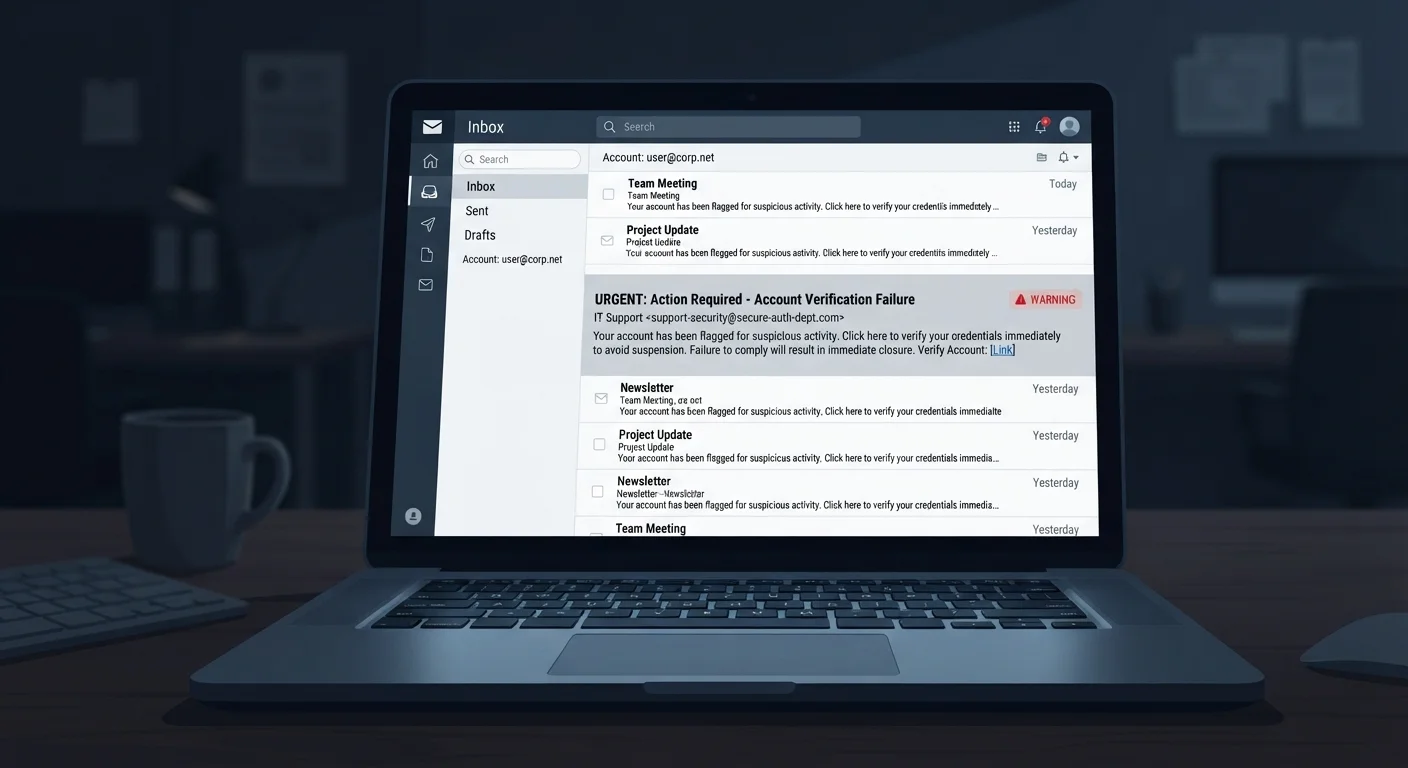
Why Phishing Still Works on Intelligent People
Phishing — the practice of sending deceptive emails designed to steal login credentials, financial information, or personal data — has evolved far beyond the obvious misspelled messages of the early 2000s. Today's attacks are crafted with near-perfect logos, plausible sender names, and language that closely mirrors real company communications.
Intelligence doesn't automatically protect you. Phishing exploits psychological patterns, not knowledge gaps. When you're rushed, tired, or emotionally triggered by an email that appears to come from your bank or employer, your brain tends to act on the feeling before the facts. Attackers deliberately design messages to produce exactly that response.
Understanding why these attacks succeed is the first step to recognizing them. The mistakes below represent the most common ways even careful people get caught out — and how to stop each one.
Trusting a familiar logo or brand name as proof of legitimacy.
Why it happens: Logos, color schemes, and email templates are publicly visible and trivially easy to copy. Our brains associate visual familiarity with safety, so a well-copied design shortcuts critical thinking.
Acting immediately on emails that create a sense of urgency or threat.
Why it happens: Messages warning that your account will be locked, a payment failed, or a package is held deliberately trigger stress, which narrows attention and pushes people toward fast, unthinking action.
Assuming a personalized greeting means the email is trustworthy.
Why it happens: Mass data breaches have exposed billions of names and email addresses. Attackers routinely use this data to address targets by first and last name, creating a false sense of legitimacy.
Clicking links in emails to "verify" account information.
Why it happens: Phishing emails frequently impersonate banks, payment platforms, and government agencies and ask recipients to confirm details through a link. This feels routine because legitimate services sometimes send similar emails.
Ignoring subtle domain misspellings in sender addresses and URLs.
Why it happens: Attackers register domains that look nearly identical to real ones — swapping letters, adding hyphens, or using different top-level domains (e.g., .net instead of .com). These differences are easy to miss when scanning quickly.
Quick Checks That Expose Most Phishing Attempts
Once you know the patterns attackers rely on, a brief pause before acting on any unexpected email can make all the difference. A few habits dramatically reduce your risk:
- Inspect the sender address, not just the display name. The name shown in your inbox (e.g., "PayPal Support") can say anything. The actual email domain — visible by clicking or hovering on the sender — is what matters. A real PayPal email will always end in
@paypal.com, not@paypal-secure-alerts.net. - Hover over every link before clicking. Your browser or email client shows the destination URL when you hover. If the link in a "Chase Bank" email points to a random string of characters or an unfamiliar domain, don't click it. For more guidance on this habit, see our quick safety checklist for everyday browsing.
- Go directly rather than clicking. If an email claims your account needs attention, open a new browser tab and navigate directly to the company's official website instead of using the email's link.
- Enable multi-factor authentication (MFA). Even if a phishing email successfully captures your password, MFA adds a second barrier that most attackers cannot overcome without access to your physical device.
Never Share Credentials Over Email
No legitimate bank, government agency, or major online platform will ask you to reply to an email with your password, Social Security number, or full payment card details. If any email — however convincing it looks — makes this request, treat it as fraudulent. Report it using your email provider's built-in phishing reporting tool and delete it without responding.
Phishing awareness is similar in principle to reading any kind of persuasive content critically — much like learning to decode marketing language, as explored in our article on reading labels without getting tricked. The underlying skill is the same: slow down, look past the surface, and ask what the message is really trying to get you to do.
The content on this site is for informational purposes only and is not a substitute for professional advice. Always consult a qualified professional for guidance specific to your situation.