

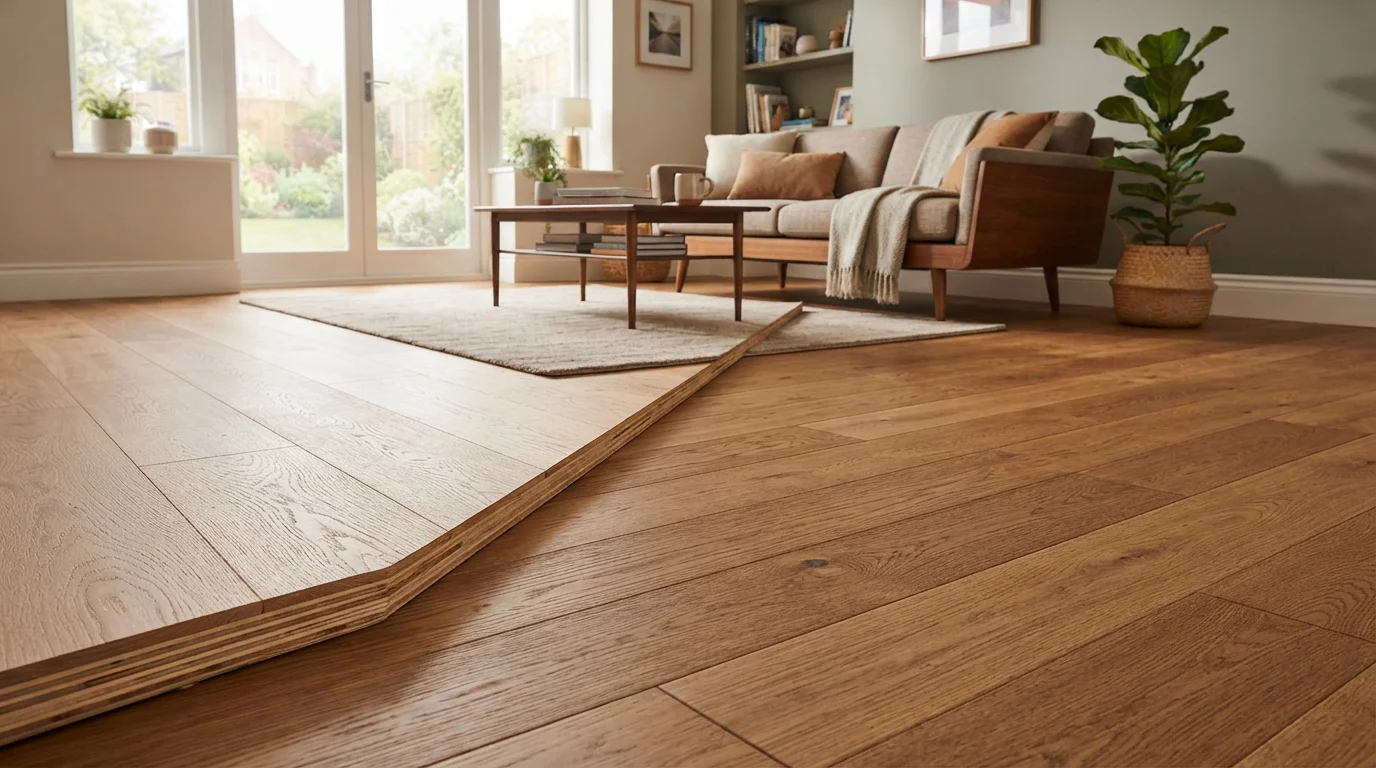
Option A
Engineered Hardwood
The moisture-resilient, versatile modern option.
Best for: Homeowners who want real wood aesthetics in spaces prone to humidity shifts, including basements and kitchens.
Option B
Solid Hardwood
The classic, long-lasting choice for dry, stable spaces.
Best for: Homeowners seeking maximum longevity and the ability to refinish floors multiple times over decades.
What's Actually Inside Each Type of Flooring
Despite looking nearly identical once installed, engineered and solid hardwood are built very differently - and that construction determines almost everything about how they behave in your home.
Solid hardwood is exactly what it sounds like: a single piece of wood milled from top to bottom, typically ¾ inch thick. Species like oak, maple, and hickory are common. That uniform thickness is what allows repeated sanding and refinishing over the decades.
Engineered hardwood is a layered product. A thin slice of real hardwood - called the veneer or wear layer - sits on top of a core made from multiple plywood layers glued in opposing directions. This cross-grain construction is what gives engineered wood its stability. The wear layer thickness varies by product, typically ranging from about 1-6 mm, and that determines how many times the floor can be refinished.
Both types use real wood on their surfaces, so they share the warmth and character that make hardwood floors appealing in the first place.
| Criterion | Engineered Hardwood | Solid Hardwood |
|---|---|---|
| Construction | Real wood veneer over plywood core | Single solid piece of wood |
| Typical thickness | 3/8 to 9/16 inch | ¾ inch (standard) |
| Moisture tolerance | Good - stable in humidity swings | Limited - prone to cupping/gapping |
| Below-grade installation | Generally suitable | Not recommended |
| Times refinishable | 1-3 times (depends on veneer thickness) | 5-7 times typically |
| Typical lifespan | 25-50+ years | 80-100+ years |
| Installation methods | Nail, staple, glue, or float | Nail or staple only |
| Relative cost | Generally lower | Generally higher |
Moisture, Stability, and Where Each Floor Can Go
Moisture tolerance is where these two floors diverge most sharply. Wood expands when it absorbs moisture and contracts when it dries out. Solid hardwood, being one solid piece, moves significantly with those changes - which is why it's generally not recommended for basements, bathrooms, or over radiant heat systems without careful precautions.
Engineered hardwood's plywood core resists that movement. The alternating grain directions of each layer pull against each other, keeping the plank relatively stable. This makes it a practical choice for below-grade installations, spaces near kitchens, or homes in regions with wide seasonal humidity swings.
That said, engineered hardwood isn't waterproof. Prolonged standing water will still damage it, and it shouldn't be confused with luxury vinyl plank (LVP), which is a fully synthetic, water-resistant product. If you're dealing with a damp basement prone to flooding, neither hardwood type is the right call.
For above-grade rooms with controlled indoor humidity - living rooms, bedrooms, main-floor hallways - solid hardwood performs very well and can last well over a century with regular care. Just keep indoor humidity in a stable range (generally between 35-55% relative humidity) to minimize seasonal movement in either floor type.
Lifespan, Refinishing, and Long-Term Value
Solid hardwood's biggest advantage is longevity through refinishing. Because the plank is thick throughout, it can be sanded down and refinished multiple times - typically somewhere between 5-7 times over its life - restoring a worn surface to like-new condition. Homes with original solid hardwood floors from the early 1900s are common, which tells you something about the ceiling on its lifespan.
Engineered hardwood's refinishing potential depends almost entirely on the wear layer thickness. A 1-2 mm veneer may allow only one light sanding. A 4-6 mm veneer can be refinished two or three times. If you're comparing engineered products, the wear layer thickness is one of the most important specs to ask about.
Finish quality also matters for both types. Both solid and engineered hardwood floors can be finished with site-applied oil or polyurethane, or purchased pre-finished from the factory. Factory finishes are harder and more consistent, but site-applied finishes offer more flexibility in sheen and color. Speaking of sheen, your finish choice affects how the floor looks day to day - much the same way paint finishes affect walls in different lighting conditions.
¾ inch
Standard solid hardwood thickness
This consistent thickness is what allows solid hardwood to be sanded and refinished repeatedly over its lifespan.
35-55%
Recommended indoor relative humidity for hardwood floors
Keeping humidity in this range, as commonly cited by flooring industry guidance, helps minimize seasonal expansion and contraction in both floor types.
1-6 mm
Engineered hardwood wear layer range
The thicker the veneer layer, the more times an engineered floor can be sanded - a key spec to check when comparing products.
Installation and Practical Considerations
Solid hardwood is typically nailed or stapled to a wood subfloor - it needs something to grip. Engineered hardwood is more flexible: it can be nailed, stapled, glued down, or floated (where planks interlock and rest on an underlayment without being fastened to the subfloor). That installation flexibility is part of why engineered hardwood works in more scenarios.
Both require an acclimation period before installation - leaving the flooring in the room for several days so the wood adjusts to the home's temperature and humidity before being fastened down. Skipping this step is a common source of post-installation buckling or gapping.
Subfloor flatness matters for both types. Any significant dips or humps in the subfloor will telegraph through the finished floor. If your subfloor isn't level within about 3/16 inch over a 10-foot span (a commonly referenced industry standard), it will need attention before installation begins.
For most main-floor renovation projects in a typical US home, either product can work well. The decision often comes down to the specific room, your local climate, and how long you plan to stay in the home. If you're renovating to sell, engineered hardwood's lower price point and broader installation flexibility may make more sense. If you're putting down floors you intend to pass along to the next generation, solid hardwood's refinishing potential is hard to beat.
The content on this site is for informational purposes only and is not a substitute for professional advice. Always consult a qualified professional for guidance specific to your situation.