

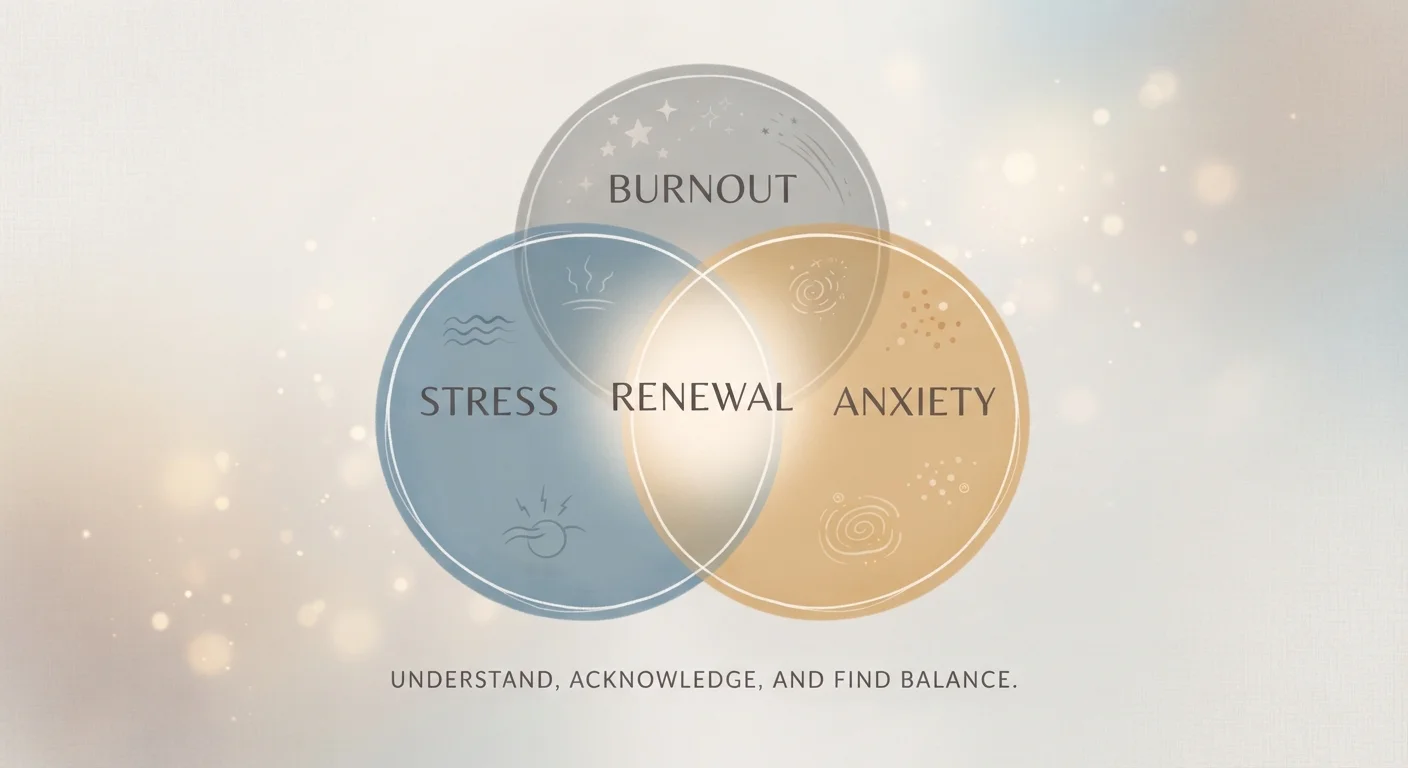
Option A
Stress & Anxiety
The activated, future-facing responses.
Best for: Understanding short-term overwhelm and worry that feels tied to specific triggers or upcoming events.
Option B
Burnout
The prolonged, depleted endpoint.
Best for: Recognizing chronic exhaustion and emotional detachment that builds over months of sustained overload.
Why the Distinctions Actually Matter
Stress, anxiety, and burnout are often used as if they mean the same thing — a kind of catch-all for feeling overwhelmed. But they describe genuinely different experiences with different causes, timelines, and patterns. That matters because the way you respond to each should vary. Trying to power through burnout the way you'd manage a stressful week, for example, can make things meaningfully worse.
This isn't about self-diagnosing. It's about building enough awareness to know when rest, when a conversation with a doctor, or when a bigger life change might be what's actually needed. For a broader foundation on these concepts, what mental wellness actually means is a helpful starting point.
| Criterion | Stress & Anxiety | Burnout |
|---|---|---|
| Primary cause | Identifiable stressor or perceived future threat | Prolonged, unrelieved demands over time |
| Emotional tone | Activated, tense, worried | Flat, detached, empty |
| Energy level | Often heightened or erratic | Chronically depleted |
| Relationship to rest | Rest typically helps, at least temporarily | Rest alone often insufficient to restore |
| Timeline | Can be acute (hours to weeks) | Develops over months |
| Resolves when stressor lifts? | Often yes (stress); not always (anxiety) | Rarely — structural change usually needed |
Stress: A Normal Response to Real Demands
Stress is the body and mind's response to external pressure — a tight deadline, a difficult conversation, financial strain, or a health scare. The American Psychological Association describes stress as typically being tied to an identifiable stressor. When the stressor resolves, so does the stress, at least in principle.
Physiologically, stress activates the body's fight-or-flight system: heart rate increases, muscles tense, and attention sharpens. This response is adaptive in short bursts. The problem arises when stressors pile up faster than they resolve, leaving the nervous system in a prolonged activated state.
Common signs of stress include irritability, difficulty concentrating, disrupted sleep, and tension headaches. These symptoms are real — but they're also generally proportional to circumstances. Exploring coping strategies for stress can help you distinguish approaches that genuinely help from ones that only delay relief.
Anxiety: When the Alarm Stays On
Anxiety shares some surface-level features with stress — racing thoughts, restlessness, physical tension — but the underlying pattern is different. With anxiety, the sense of threat often persists even when no clear external stressor is present. The worry may feel difficult to control, may jump from one concern to another, and may involve anticipating problems that haven't happened.
The National Institute of Mental Health notes that anxiety disorders are among the most common mental health conditions in the U.S. Not every experience of anxiety meets the threshold for a clinical disorder, but persistent anxiety that interferes with daily life is worth discussing with a healthcare professional.
19.1%
U.S. adults affected by anxiety disorders annually
According to the National Institute of Mental Health, anxiety disorders affect nearly one in five American adults each year.
~77%
Workers who have experienced burnout symptoms
A Deloitte workplace survey found that a large majority of respondents reported experiencing burnout at their current job at some point.
One useful way to think about it: stress tends to say "I have too much to do." Anxiety tends to say "something bad is going to happen" — even when everything is, technically, fine.
Burnout: The Cost of Chronic Overload
Burnout is not just extreme tiredness. The World Health Organization classifies burnout as an occupational phenomenon — the result of chronic workplace stress that hasn't been successfully managed. It's characterized by three core dimensions: emotional exhaustion, depersonalization (feeling detached or cynical), and a reduced sense of personal accomplishment.
Burnout builds slowly. People often don't notice it until they've already crossed into a state of emotional flatness — not the agitation of stress or anxiety, but a kind of hollowness. Tasks that once felt meaningful feel pointless. Rest doesn't seem to restore energy the way it should.
Because burnout develops over months, recovery also takes time. It often requires addressing the structural conditions that caused it — not just self-care practices, though those play a role too. It's worth being aware that good intentions around self-care can sometimes backfire when the root cause isn't addressed.
This article is for general informational purposes only and does not constitute medical or mental health advice. If you're experiencing persistent distress, please consult a qualified healthcare or mental health professional.
The content on this site is for informational purposes only and is not a substitute for professional advice. Always consult a qualified professional for guidance specific to your situation.