

Why Movement Patterns Matter More Than Exercises
When people think about getting fit, they often fixate on specific exercises — push-ups, squats, lunges — without realizing that those exercises belong to broader categories called movement patterns. Understanding patterns is more useful than memorizing exercise names, because once you know a pattern, you can adapt it to your ability level, your available space, and how your body feels on any given day.
Most human movement breaks down into six foundational patterns: squat, hinge, push, pull, single-leg, and carry. Master the basics of these and you'll have the physical literacy to follow almost any workout — at home, in a gym, or anywhere in between. If you're still building the habit of moving regularly, our practical first-month guide is a great companion to this article.
A Note on Soreness vs. Pain
Mild muscle soreness 24–48 hours after exercise is normal and generally a sign that your muscles are adapting. Sharp, sudden, or joint-focused pain during a movement is a different signal — it's a cue to stop, rest, and speak with a healthcare provider if it persists. When in doubt, ease back and get guidance from a qualified professional before continuing.
The Six Patterns
The Squat
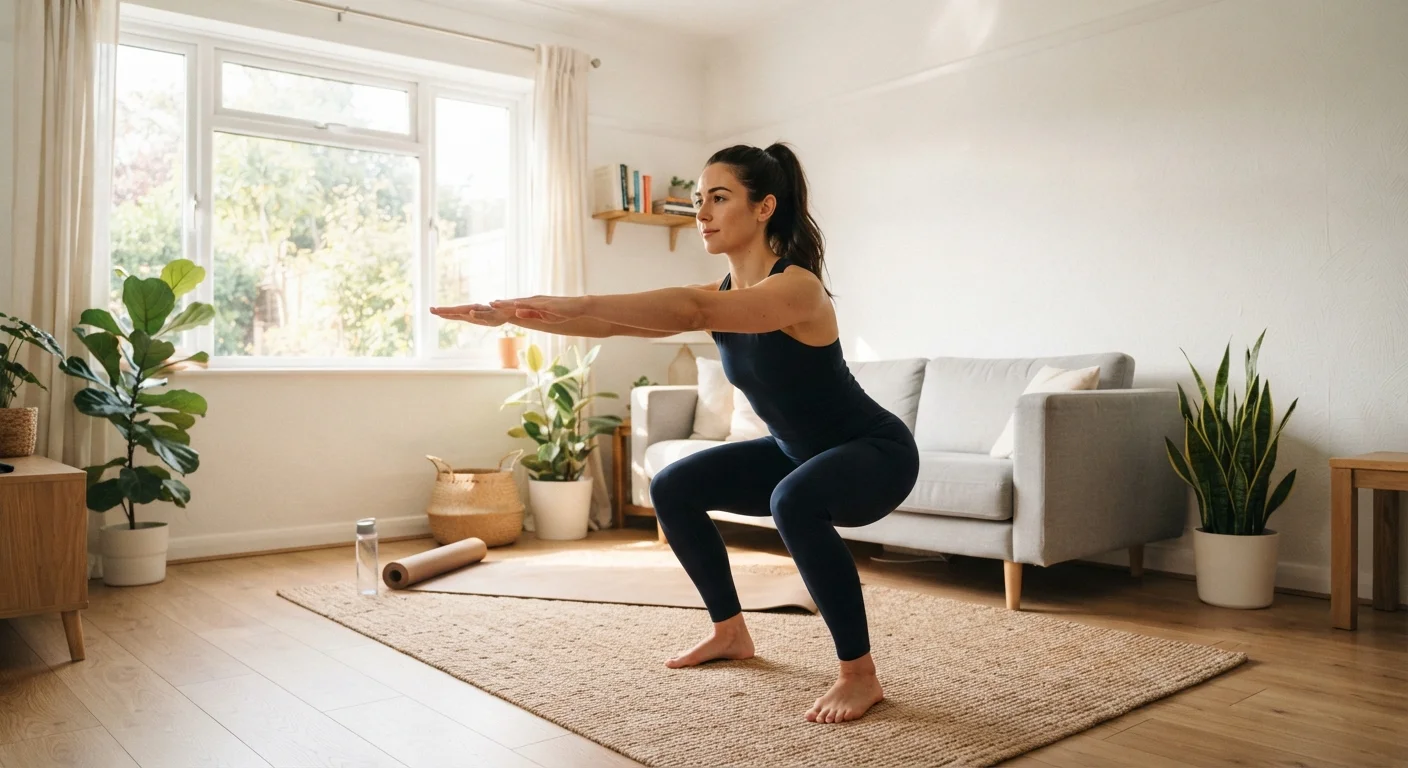
The squat is arguably the most fundamental human movement — it's how we sit down and stand up. In exercise, a bodyweight squat involves standing with feet roughly shoulder-width apart, then lowering your hips back and down as if sitting into a chair, keeping your chest lifted and knees tracking over your toes.
Squats primarily work your quadriceps (front of the thighs), glutes, and hamstrings while also engaging your core for balance. If lowering all the way down feels challenging at first, squatting onto the edge of a chair and standing back up is a completely legitimate starting point — and a great way to build confidence in the pattern.
Squatting onto a chair and standing up is a legitimate, effective starting point for total beginners.
The Hip Hinge
The hip hinge teaches you to bend at the hips rather than rounding your lower back — a distinction that matters enormously for spinal health. To practice it, stand with feet hip-width apart, soften your knees slightly, and push your hips back while keeping your back flat, as though you're trying to close a car door with your backside.
This pattern is the foundation for deadlifts and Romanian deadlifts, but at the beginner level, a simple standing hinge or a glute bridge (lying on your back and pressing your hips toward the ceiling) are excellent ways to train the same muscles: hamstrings, glutes, and the lower back.
The hip hinge protects your lower back by teaching you to load the hips, not the spine.
The Push
Pushing movements train the chest, shoulders, and triceps. The classic example is the push-up, which is also a tremendous core exercise when performed with a straight, rigid body line from head to heels.
If a full push-up isn't accessible yet, an incline push-up — hands placed on a countertop, bench, or wall — reduces the load significantly without changing the movement pattern. Over time, as strength improves, you simply lower the surface until you're working on the floor. There's no rush, and there's no shame in starting at the wall. Progress is progress.
An incline push-up uses the same pattern as a full push-up — just with less load on your joints.
The Pull
Pulling movements are the counterpart to pushing — they work the upper back, biceps, and rear shoulders. Because most of us spend hours hunched over screens, strengthening these muscles is particularly valuable for posture and shoulder health.
Without equipment, the pull pattern can be practiced using a sturdy table: lie underneath it, grip the edge, and pull your chest up toward it (an inverted row). Resistance bands looped over a door anchor also allow beginner-friendly pulling movements. If a gym is accessible, an assisted pull-up machine or lat pulldown are great starting points.
Pulling movements counteract the forward-rounding posture most of us develop from daily screen time.
The Lunge (Single-Leg Pattern)
Single-leg movements like lunges train balance and coordination alongside strength, and they reveal asymmetries between your left and right sides that bilateral (two-legged) exercises can mask. A basic forward lunge involves stepping one foot forward, lowering your back knee toward the floor, then returning to standing.
If balance is a challenge — which is completely normal early on — holding a wall or chair for support is encouraged. A reverse lunge (stepping back rather than forward) tends to feel more stable for many beginners and places slightly less strain on the knee, making it a sensible starting variation.
Single-leg movements reveal strength imbalances between sides that squats and hinges can't expose.
The Carry (Core and Stability Pattern)
Often overlooked in beginner programs, the carry — simply walking while holding or bracing weight — trains the core to resist movement rather than create it. This "anti-movement" function of the core is how it operates in everyday life: stabilizing your spine while you carry groceries, hold a child, or simply walk.
A beginner-friendly version is the farmer's carry: hold a bag of rice or a heavy book in each hand, stand tall, brace your core gently, and walk slowly for 20–30 seconds. Even a dead-hang plank captures a similar idea — your core is working to hold a position, not to crunch or twist.
Your core's most important job is stabilizing your spine — not crunching. The carry trains exactly that.
Start With Two or Three Patterns Per Session
You don't need to practice all six movements in every workout. Pick two or three patterns — say, a squat, a push, and a hinge — and do two to three sets of each with good form. This keeps sessions short, manageable, and sustainable, which is exactly what beginners need to build a consistent habit.
Putting It All Together
None of these patterns exist in isolation. A strong squat helps your lunge; a better hip hinge improves your posture during carries; pushing and pulling in balance keeps your shoulders healthy. That's why even a short, simple session touching two or three of these patterns delivers real, compounding benefit over time.
You don't need to be performing perfect reps from day one. Common fitness myths often make beginners feel like form has to be flawless before they can start — it doesn't. Starting messy and refining over time is exactly how movement learning works.
Once these patterns feel familiar, building a simple weekly routine around them is a natural next step. And if you're weighing whether to add cardio alongside strength work, this comparison of cardio and strength training can help you think it through.
This article is for general informational purposes only and is not a substitute for personalized advice from a qualified healthcare or fitness professional. If you have any existing health conditions or injuries, consult a professional before starting a new exercise program.
The content on this site is for informational purposes only and is not a substitute for professional advice. Always consult a qualified professional for guidance specific to your situation.