

Option A
Whole Grains
The complete, minimally processed kernel.
Best for: People looking to increase fiber, B vitamins, and minerals through everyday food choices.
Option B
Refined Grains
The stripped-down, longer-lasting alternative.
Best for: Situations where texture, shelf life, or digestibility is prioritized — though they contribute fewer nutrients.
What Happens Inside the Grain During Processing
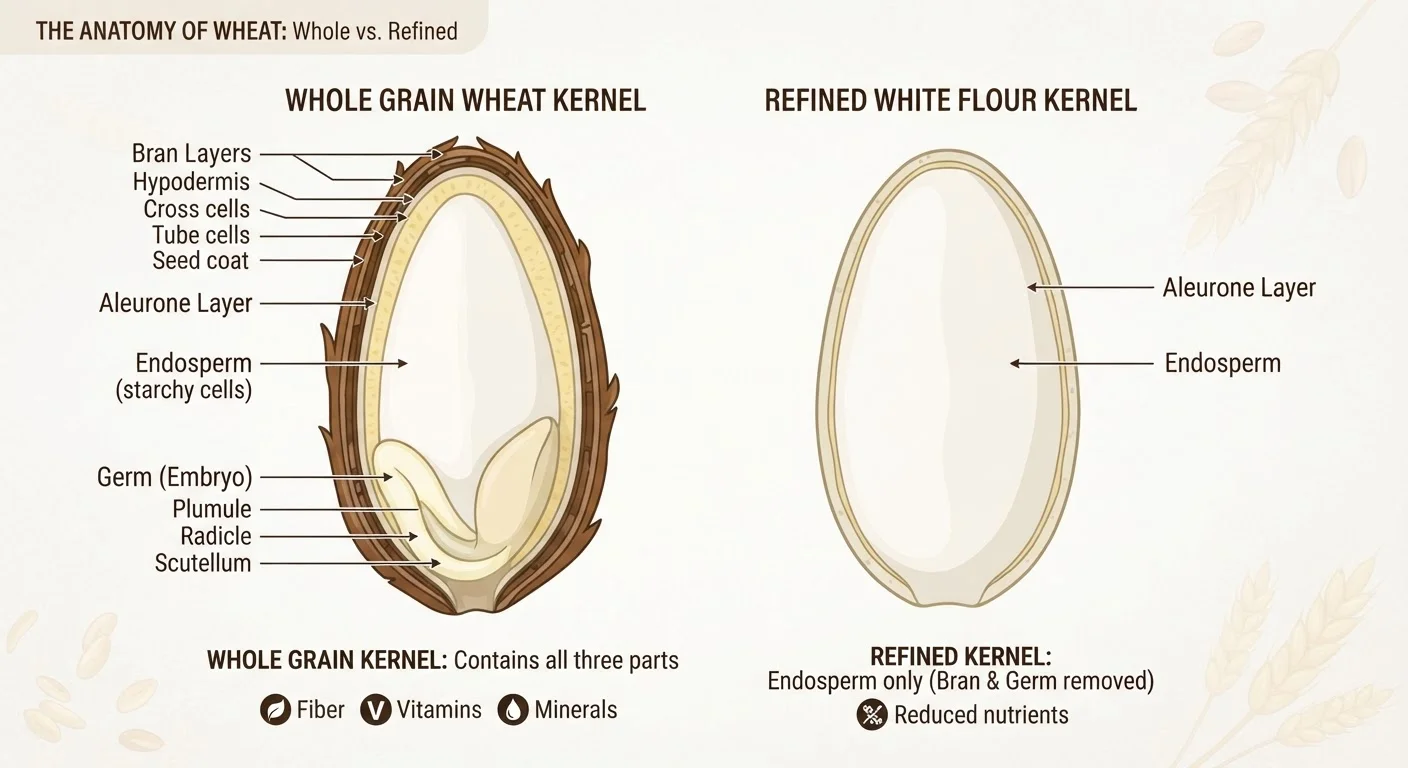
A grain kernel — whether it comes from wheat, oats, corn, or rice — is naturally made up of three distinct layers. The bran is the tough outer coating, rich in fiber and B vitamins. The germ is the inner embryo of the seed, packed with healthy fats, antioxidants, and additional B vitamins. The endosperm is the starchy middle section that makes up the bulk of the kernel.
When a grain is whole, all three layers are intact. When it's refined, the bran and germ are removed — usually through milling — leaving only the endosperm. This dramatically changes the nutritional profile. Most of the fiber, iron, magnesium, and B vitamins (including folate, thiamine, and niacin) are concentrated in the bran and germ. Removing those layers means removing most of those nutrients.
The endosperm is mostly starch and some protein, which is why refined grain products like white flour and white rice digest quickly and have a milder flavor and softer texture. These qualities have made refined grains commercially popular for centuries — but the trade-off nutritionally is significant.
| Criterion | Whole Grains | Refined Grains |
|---|---|---|
| Parts of kernel retained | Bran, germ, and endosperm | Endosperm only |
| Fiber content | High | Low (rarely restored) |
| B vitamins | Naturally present | Partially added back if enriched |
| Minerals (iron, magnesium, zinc) | Naturally present | Mostly removed; some iron restored |
| Healthy fats | Present (from germ) | Removed with germ |
| Shelf life | Shorter (oils in germ can go rancid) | Longer |
| Texture | Denser, heartier | Lighter, softer |
| Common examples | Whole wheat bread, brown rice, oats | White bread, white rice, white pasta |
Enrichment: Some Nutrients Come Back, but Not All
In the United States, many refined grain products are labeled enriched. This means manufacturers have added back certain nutrients — typically iron and several B vitamins — that were lost during milling. Enrichment has played a genuine public health role: the addition of folic acid to enriched grain products, for example, has been associated with significant reductions in neural tube defects.
However, enrichment does not restore everything. Fiber — arguably one of the most valuable components lost during refining — is almost never added back in meaningful amounts. Magnesium, zinc, and other minerals also remain largely absent. So while enriched grains are nutritionally better than non-enriched refined grains, they still don't match the full profile of a whole grain.
A Note on Fortification vs. Enrichment
Enrichment refers to restoring nutrients lost during processing — like adding B vitamins back to white flour. Fortification means adding nutrients that weren't originally in the food at all, such as adding vitamin D to milk. Both are regulated by the FDA. Neither process makes a refined grain nutritionally equivalent to a whole grain, but both have meaningful public health benefits in specific contexts.
Understanding the difference between macronutrients and micronutrients can help put this into context. See our guide to macronutrients and micronutrients for a plain-language breakdown of what each category does in your body.
How to Actually Spot a Whole Grain on a Label
Front-of-package marketing can be misleading. Words like multigrain, wheat bread, or made with whole grain don't guarantee a product is primarily whole grain. The most reliable method is to check the ingredient list on the back of the package.
Look for the word "whole" as the first word in the grain ingredient — for example, "whole wheat flour," "whole oats," or "whole grain corn." If the first grain listed is simply "wheat flour," "enriched flour," or "rice flour," the product is primarily refined, regardless of what the front label implies.
≥50%
Recommended share of grains that should be whole
The U.S. Dietary Guidelines for Americans recommend that at least half of all grains consumed each day come from whole grain sources.
25%
Average American whole grain intake vs. recommended
Research cited by the Whole Grains Council suggests most Americans consume well below the recommended amount of whole grains daily.
It's also worth noting that color alone isn't a reliable indicator. Some brown breads get their color from molasses or caramel coloring, not from whole grain content. Reading labels carefully is the only way to know for sure.
If you're already paying attention to grain choices, you may also find it useful to understand how naturally occurring and added sugars appear on food labels — our explainer on sugar in food walks through what those label terms actually mean.
This article is for general informational and educational purposes only and is not a substitute for professional medical or nutritional advice. If you have questions about your diet or specific health conditions, please consult a qualified healthcare provider.
The content on this site is for informational purposes only and is not a substitute for professional advice. Always consult a qualified professional for guidance specific to your situation.