

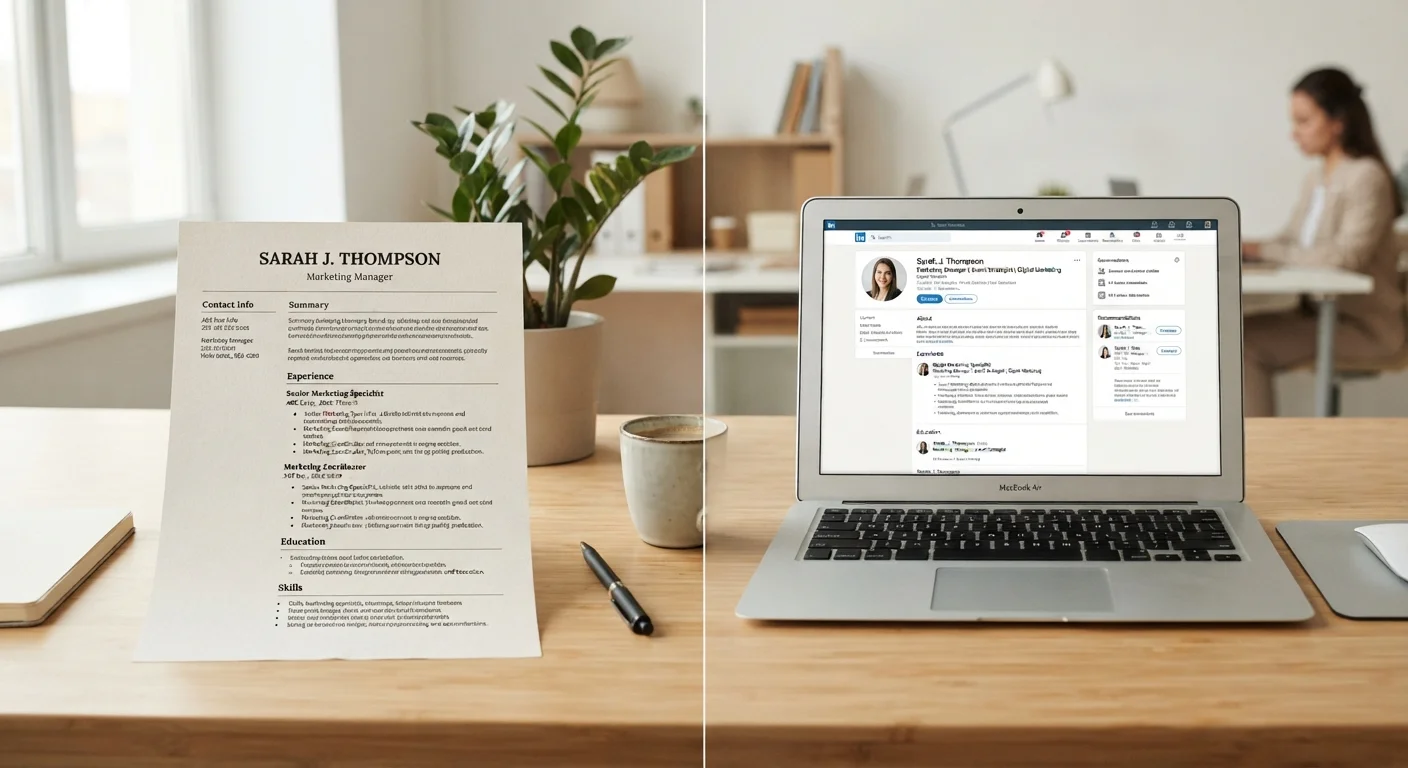
Option A
LinkedIn Profile
Your always-on professional presence.
Best for: Networking, being discovered by recruiters, and building your professional brand over time.
Option B
Résumé
A targeted document built for a specific opportunity.
Best for: Applying directly to roles and passing employer screening processes, including applicant tracking systems.
Different Documents, Different Jobs
Many job seekers treat their LinkedIn profile as an online version of their résumé. That's a missed opportunity - and occasionally a liability. The two documents work differently, speak to different audiences, and succeed by different rules.
Your résumé is a targeted pitch. It's created for a specific role, shaped around a job description, and handed directly to a hiring team. It exists to get you an interview. Your LinkedIn profile, by contrast, is a persistent professional identity - visible to anyone, searchable, and meant to communicate your value across time and context, not just for one role.
Understanding that distinction changes how you approach both. Common job search myths often blur this line, leading people to write one generic document and paste it everywhere - which serves neither purpose well.
How Recruiters and Hiring Managers Use Each
Recruiters and hiring managers often play different roles in the hiring process, and they tend to lean on different tools.
Recruiters - especially those sourcing candidates proactively - rely heavily on LinkedIn. They use keyword searches, filter by location and experience, and scan profiles looking for a fit before anyone has applied anywhere. A strong LinkedIn presence means you can be found even when you're not looking.
Hiring managers typically see résumés after the sourcing stage. At that point, they're comparing a short list of candidates against a specific job description. Here, relevance and precision matter. A résumé that mirrors the language of the role tends to perform better - both with human readers and with the applicant tracking systems (ATS) many companies use to screen applications before a human ever sees them.
| Criterion | LinkedIn Profile | Résumé |
|---|---|---|
| Primary audience | Recruiters, network, employers | Hiring manager for a specific role |
| Visibility | Public and searchable | Shared only when you apply |
| Length | No strict limit | Typically one to two pages |
| Tone | Conversational, first-person | Formal, achievement-focused |
| Customisation | One version for all audiences | Tailored per application |
| Social proof | Recommendations, endorsements | References listed separately |
| ATS compatibility | Not applicable | Critical for most applications |
This is why where you apply also matters - different channels route your materials through different systems.
What Each Document Should Contain
The content overlap between a LinkedIn profile and a résumé is real, but the treatment of that content should differ significantly.
LinkedIn Profile
- Summary (About section): Written in first person, conversational, showing personality and professional direction - not a dry career recap.
- Experience: Broader than a résumé. You can include older roles, part-time work, freelance projects, and volunteer activity that you'd trim from a tailored résumé.
- Skills and endorsements: Add all relevant skills - LinkedIn's algorithm surfaces profiles partly based on skill matches.
- Recommendations: Written references from colleagues or managers add social proof that a résumé simply can't replicate.
Résumé
- Summary or objective: Optional, but if included, it should be tightly aligned to the specific role.
- Experience: Curated and tailored. Lead with impact - quantified results where possible - and mirror language from the job posting.
- Length: Generally one to two pages. Older or less relevant roles may be cut entirely.
- Format: Clean, ATS-friendly structure. Avoid tables, graphics, or text boxes that can confuse automated parsing tools.
For practical help adapting your résumé without starting from scratch, see this guide on tailoring efficiently.
Keeping Both Aligned - Without Making Them Identical
The facts on both documents must match. Dates, job titles, and employers that conflict between LinkedIn and your résumé raise immediate red flags during background verification - a step most employers take before extending an offer.
That said, alignment in facts doesn't mean identical language. Your résumé might highlight three key achievements from a role; your LinkedIn can tell the fuller story of what that role involved. Your résumé headline is role-specific; your LinkedIn headline can position you for a career direction rather than a single job title.
Where you're heading professionally - whether that's moving up or moving laterally - should come through consistently in both documents, even if the depth and framing differ.
A Note on Profile Photos and Privacy
LinkedIn profiles are public by default, which means your photo, headline, and summary are visible to anyone - including current employers. If you're conducting a confidential search, adjust your LinkedIn privacy settings to limit activity broadcasts. For example, you can turn off notifications to your network when you update your profile. Your résumé carries no such risk, since you control exactly who receives it.
Review both documents together at least once before starting any serious job search. Catching inconsistencies early is far easier than explaining them in an interview.
The content on this site is for informational purposes only and is not a substitute for professional advice. Always consult a qualified professional for guidance specific to your situation.