

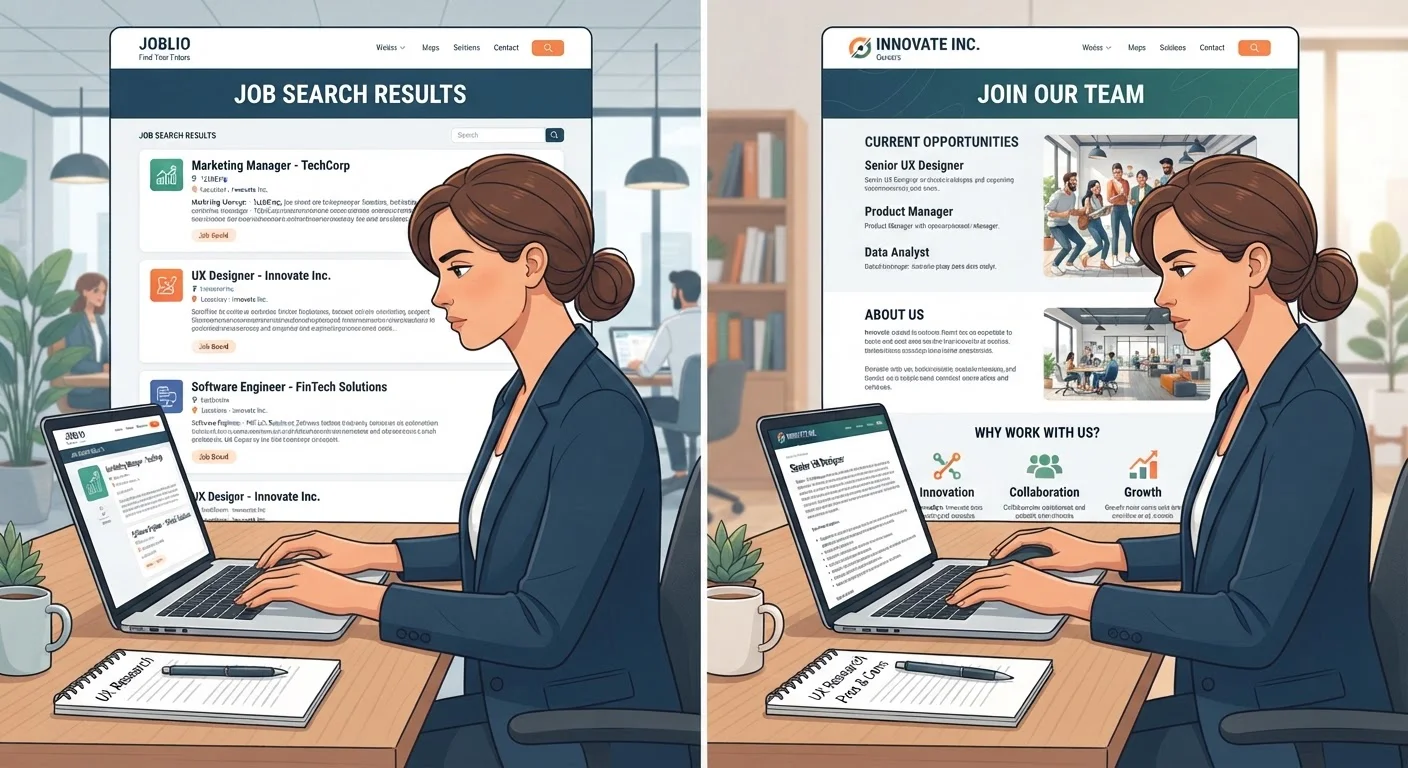
Option A
Job Boards
The wide-net, high-volume application channel.
Best for: Job seekers who want broad market visibility and fast access to many listings in one place.
Option B
Direct Company Websites
The focused, employer-native application route.
Best for: Candidates targeting specific employers who want their application seen in full, unfiltered context.
What Actually Happens When You Hit Submit
Most job seekers assume that where they apply is just a matter of convenience. In reality, the channel you choose affects how your application is received, processed, and sometimes ranked - though the differences are more nuanced than most advice suggests.
At the core of this comparison is one key fact: the majority of mid-to-large employers use an applicant tracking system (ATS) - software that collects, stores, and filters applications. Whether you apply through a job board or the company's own careers page, your résumé almost always ends up inside that same ATS. The question is how it gets there, and whether anything is lost or changed along the way. See our guide to how ATS software works for a deeper breakdown of what happens behind the scenes.
Understanding this helps cut through a lot of the mythology around the "right" way to apply - and lets you make smarter choices based on your actual situation.
How Job Boards Work - and Where They Fall Short
Job boards - platforms that aggregate listings from multiple employers - are most people's first stop in a job search, and for good reason. They offer a single interface to browse thousands of roles, filter by location and salary, and apply quickly.
But there are some consistent limitations worth knowing:
- Posting delays: Job boards pull listings from employer systems, sometimes with a lag. A role you see today may have been posted days earlier on the company's own site - or may already be filled.
- Incomplete information: Some employers post truncated job descriptions on boards, with full details only on their careers page. This can make it harder to tailor your application accurately. Our guide to reading job descriptions strategically explains what to look for before applying.
- Application data handling: When a job board submits your application on your behalf, there can occasionally be formatting issues - especially with résumés parsed by the board's own system before being passed to the employer's ATS.
| Criterion | Job Boards | Direct Company Websites |
|---|---|---|
| Listing breadth | Thousands of roles in one place | Only that employer's open roles |
| Posting freshness | Can lag behind by days | Updated in real time |
| Job description completeness | Often truncated | Full, authoritative version |
| Exclusive listings | Rarely available | Accessible here only |
| Application formatting risk | Possible third-party parsing | Direct submission to employer ATS |
| Speed of applying | Fast, often one-click | Slower, separate logins per employer |
| Best use case | Discovery and market scanning | Targeting specific employers |
That said, job boards are genuinely useful for market discovery - understanding what roles exist, what salaries look like, and which employers are actively hiring.
What Applying Directly Actually Changes
When you apply through a company's own careers page, your application goes directly into their system - no intermediary parsing, no board-imposed formatting, and no chance of your materials being delayed in transit.
A few practical differences stand out:
- Complete job information: Company careers pages almost always have the full, authoritative job description - including requirements, team context, and sometimes salary ranges that don't appear on boards.
- Exclusive listings: Some roles - particularly internal transfers, executive positions, or confidential backfills - are posted only on the company site. If you're only scanning boards, you'll miss them entirely. Our piece on the hidden job market explores this further.
- Signal of intent: Some recruiters report that candidates who apply directly - and who demonstrate knowledge of the company - stand out slightly. It's not universal, but it's a real consideration when targeting employers you care about.
The trade-off is time. Navigating individual company career portals, creating separate logins, and reformatting your materials for each system is slower than using a centralized board. For that reason, direct applications make most sense when you have a genuine, specific interest in an employer.
The Smarter Way to Use Both
The most effective job seekers don't choose one channel and ignore the other - they use each for what it does well.
Use job boards for exploration: When you're mapping out the market, getting a sense of demand, or casting a wider net, boards are efficient. Just be aware of their limitations and verify key details on the company's own site before tailoring your application.
Use company sites for precision: Once you've identified employers you want to target, go directly to their careers page. You'll get accurate information, avoid potential data handling issues, and submit your application as intended.
One thing both channels share: volume alone rarely works in your favor. Research consistently suggests that sending out large numbers of generic applications produces diminishing returns. Our piece on why high-volume applying often backfires explains the evidence behind this.
70%+
Jobs filled via employer ATS
Industry estimates suggest the large majority of corporate job openings are processed through applicant tracking systems, regardless of which channel the application came through.
~20%
Roles posted only on company sites
Some workforce researchers estimate that a meaningful share of open positions never appear on third-party job boards, making direct site checks essential for thorough searches.
For a fuller picture of what happens after you submit - regardless of which channel you use - see what hiring managers actually do with your application.
The content on this site is for informational purposes only and is not a substitute for professional advice. Always consult a qualified professional for guidance specific to your situation.