

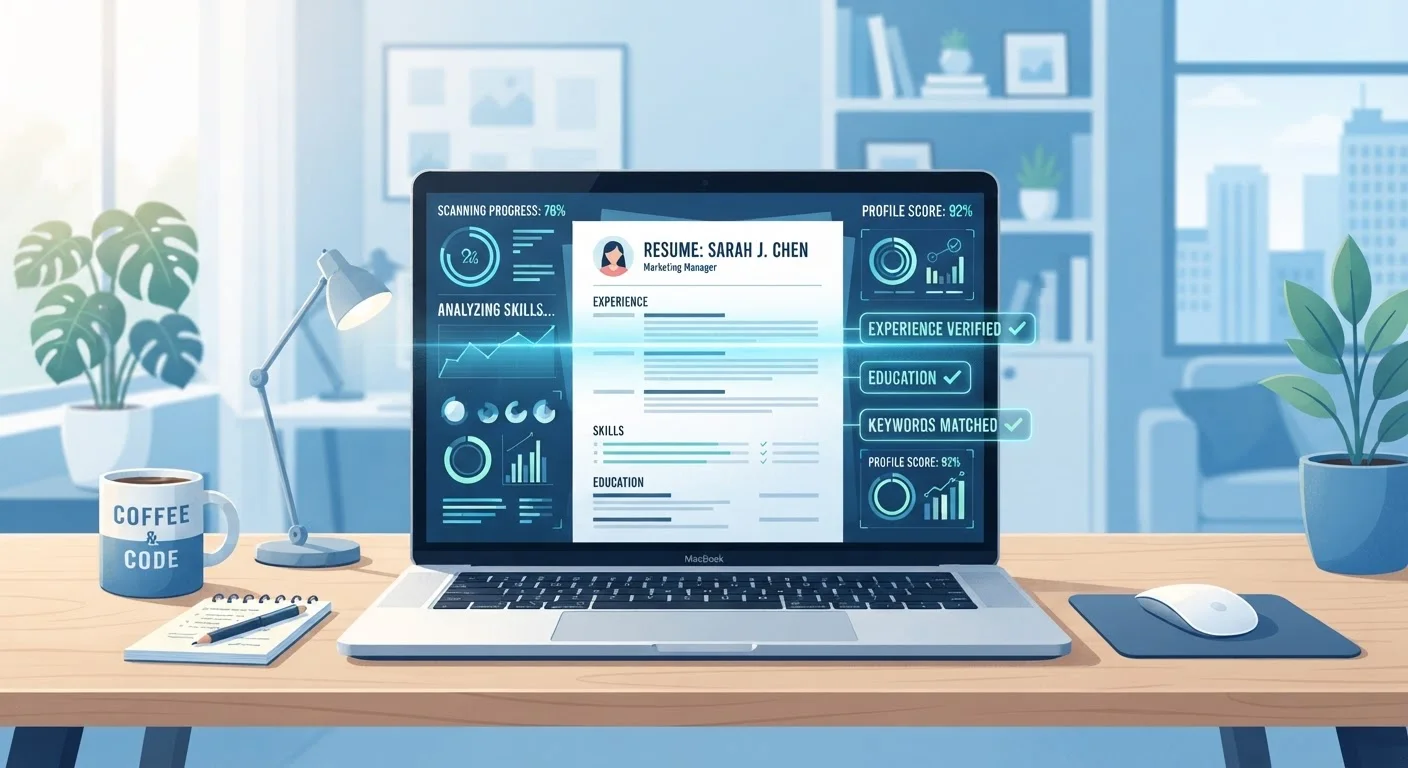
How an ATS Actually Works
When you click "Submit" on an online job application, your résumé enters an applicant tracking system. The software breaks down your document into structured data - pulling out your contact information, work history, education, and skills - and stores that information in a database alongside every other applicant for that role.
Recruiters then use the system to search, sort, and filter that pool. They might search for candidates who list a specific certification, screen out applications missing a required field, or rank results by how closely the résumé text aligns with the job description. The exact method depends on the platform and how the recruiter has configured it.
What this means for job seekers: your résumé needs to be readable by both a machine and a human. A visually impressive design that a person would find attractive can confuse parsing software if it uses text boxes, columns, or embedded graphics. What hiring managers do with your application after ATS screening is a separate question - but getting past the first filter is the prerequisite.
Test Your Résumé Before Submitting
Several free online tools let you paste a job description and your résumé to see how well they align from a keyword-matching perspective. While no tool perfectly replicates every ATS, this kind of check can surface obvious gaps between your résumé language and the posting's terminology. Treat the output as a prompt for reflection, not a definitive score.
What ATS Looks For in a Résumé
Keywords are the most discussed element of ATS optimization, and for good reason. If a job posting lists "project management" as a core requirement and your résumé only says "managed projects," some systems may not connect the two. Reading the job description carefully and reflecting its language - where it accurately describes your experience - is the most reliable way to improve your match rate.
Beyond keywords, most systems look at:
- Job titles and dates: Clear, consistently formatted work history helps the system categorize your experience accurately.
- Education fields: Degree type, institution, and graduation year are commonly parsed fields. Put these in a clearly labeled section.
- Contact information: Place your name, phone, and email at the top of the document in plain text - not in a header element that some parsers skip.
Formatting choices matter more than most people realize. Standard section headings like "Work Experience" and "Education" are more reliably parsed than creative alternatives. Single-column layouts outperform multi-column designs in most systems.
~75%
Résumés never seen by a human recruiter
Estimates cited widely in HR industry literature suggest roughly three in four résumés are filtered out before a recruiter reviews them, often due to ATS screening thresholds.
99%
Fortune 500 companies using ATS
Research by Jobscan and others has found that virtually all Fortune 500 companies rely on applicant tracking systems to manage application volume.
250+
Average applications per corporate job opening
A frequently cited figure from recruiting research indicates large employers routinely receive over 250 applications per open position, driving the need for automated screening tools.
What ATS Cannot Replace
It's worth keeping ATS in perspective. The system is a tool for managing volume - it helps recruiters handle hundreds or thousands of applications without losing track of them. It does not make hiring decisions. A human still reads shortlisted résumés, conducts interviews, and evaluates fit.
This matters because over-optimizing for software at the expense of human readability is counterproductive. A résumé that's technically well-structured but reads as a list of buzzwords won't impress the recruiter who opens it. The goal is a document that clears the automated stage and then makes a strong impression on a person.
It also means that résumé quality is only part of the picture. Applying to dozens of jobs with the same generic résumé tends to underperform compared to fewer, more targeted applications. Before submitting, run through a pre-submission checklist to make sure both the ATS-facing and human-facing elements are sound.
Practical Steps Before You Apply
You don't need to become an ATS expert to improve your chances. A few consistent habits cover most of what matters:
- Read the job description closely. Note the exact terms used for skills and qualifications you genuinely have, and use that language in your résumé.
- Use a clean, single-column format. Standard fonts, clear headings, and no text boxes or graphics keep your document parseable.
- Save as .docx or a standard PDF unless the application system specifies otherwise.
- Don't omit a section because it feels obvious. If you have relevant certifications or education, label and list them explicitly - don't assume the system will infer them.
- Tailor each application. Even small adjustments to reflect the specific role make a measurable difference compared to a one-size-fits-all résumé.
Understanding how job boards compare to applying directly on company websites can also shape how you approach your search - the path your application takes affects what system processes it.
Frequently Asked Questions
Not every employer does, but usage is widespread among companies that receive a high volume of applications. Small businesses hiring occasionally may still rely on email or simple spreadsheets. The larger the organization, the more likely an ATS is in use.
An ATS typically ranks or filters applications rather than issuing automatic rejections on its own. However, if your résumé scores poorly against the job's required criteria, it may never surface for human review - which has the same practical effect. The recruiter sees a shortlist, and low-ranking applications are often never opened.
No. Keyword relevance matters, but excessively repeating terms or listing skills you don't have can backfire at the human review stage. Focus on accurately reflecting your experience using language that mirrors the job description, rather than gaming the system.
A standard .docx or plain PDF is generally the safest choice unless the application instructions specify otherwise. Avoid heavily designed templates with graphics, text boxes, or tables, as these can cause parsing errors in many systems.
Cover letters are usually stored in the ATS but are less commonly scored by automated filters compared to résumés. They're more likely to be read - if at all - during the human review stage. That said, following the same clarity and relevance principles still applies.
The content on this site is for informational purposes only and is not a substitute for professional advice. Always consult a qualified professional for guidance specific to your situation.