

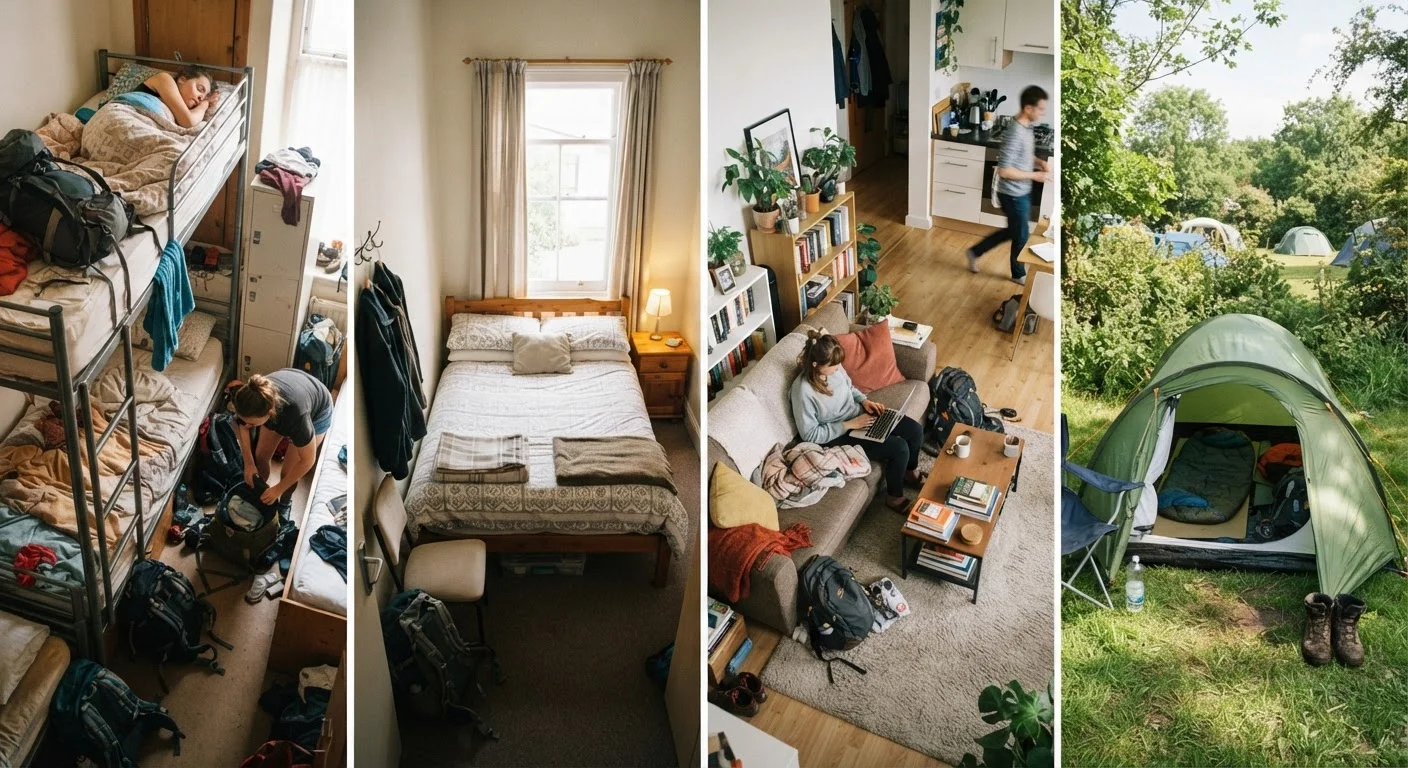
Our Verdict
No single accommodation type wins across all scenarios. The right choice depends on how long you're staying, how much privacy you need, and what you'll spend to get there. Running the numbers on total cost - not just the nightly rate - consistently leads to better decisions.
| Best for | Recommended |
|---|---|
| Solo travellers on tight nightly budgets who enjoy social settings | Hostels |
| Couples or solo travellers wanting privacy without full hotel pricing | Guesthouses |
| Groups or travellers staying a week or more in one location | Home-shares |
| Outdoor-oriented travellers with gear who want maximum daily savings | Camping |
Why the Nightly Rate Is Only Half the Story
Budget travellers naturally fixate on the nightly rate - and it's a reasonable starting point. But the true cost of any accommodation includes what you spend getting there, what amenities you pay for separately, and what comfort you sacrifice. A $20 hostel dorm that requires a $25 taxi from the airport may cost more over a weekend than a $45 guesthouse within walking distance of everywhere you're going.
Before comparing options, nail down your total accommodation spend per stay - not per night. Factor in cleaning fees, service charges, and any gear costs. The hidden costs that quietly blow up a travel budget are often baked into accommodation choices, not just flights.
Hostels: Cheap but Not Cost-Free
Dormitory-style hostels typically run between $15 and $50 per night in most US and international destinations, making them the most accessible entry point for budget travel. The social atmosphere is a genuine draw for solo travellers - meeting other people is built into the experience.
The trade-offs are real, though. Shared bathrooms, noise from late-arriving bunkmates, and limited storage are standard. Sleep quality is variable. Private rooms in hostels cost significantly more - sometimes approaching guesthouse pricing - and undercut the main financial argument for choosing a dorm.
Hostels work best for short stays in cities where you'll be out most of the day. For anything longer than three or four nights, the accumulated fatigue of a shared space starts to erode the value proposition.
| Hostels | Guesthouses | Home-Shares | Camping | |
|---|---|---|---|---|
| Typical nightly cost (US) | $15-$50 (dorm) | $40-$90 | $50-$120 (after fees) | $0-$50 |
| Privacy level | Low (shared dorm) | High (private room) | High (own space) | Moderate (site-dependent) |
| Best stay length | 1-4 nights | 2-7 nights | 5+ nights | Any (with gear) |
| Social opportunity | High | Low-moderate | Low | Moderate |
| Hidden fee risk | Low | Low | High (cleaning, service) | Low-moderate |
| Upfront cost barrier | None | None | None | Gear investment required |
| Flexibility / cancellation | Generally flexible | Varies by property | Often strict | Site-dependent |
Guesthouses: The Reliable Middle Ground
Guesthouses and budget B&Bs typically charge $40-$90 per night depending on location, and they deliver something hostels can't: a private room with a door that closes. Breakfast is sometimes included, which reduces your daily food spend. Staff are usually more attentive than at large properties, and local knowledge is often freely offered.
The downside is limited flexibility. Guesthouses often have fixed check-in windows, minimal cancellation flexibility, and fewer amenities than larger hotels. In some destinations they're abundant; in others, hard to find or inconsistent in quality. Reading recent reviews is essential - the category spans a wide quality range.
For travellers who want a predictable, private base without paying hotel rates, guesthouses consistently deliver solid value. They pair well with the realistic travel budget framework since their all-in cost is straightforward to estimate.
Home-Shares: Best for Groups and Longer Stays
Renting a room or apartment through a home-sharing platform can offer strong value, but the math only works in specific circumstances. Cleaning fees, service charges, and minimum-stay requirements often make short stays expensive relative to the nightly rate shown. A $70/night listing with a $60 cleaning fee and a 3-night minimum costs $270 before you've eaten a single meal.
Where home-shares genuinely shine: groups splitting a full apartment, and stays of a week or more where the fixed costs amortize across more nights. A kitchen also changes the food budget equation significantly. If you're travelling as a group, dividing a home-share between four people can undercut every other option.
Verify cancellation policies carefully before booking - home-share refund terms vary widely and can create financial exposure if plans change.
Camping: Lowest Cost, Highest Commitment
Campsite fees at public and private campgrounds in the US range from free (dispersed camping on public land) to around $35-$50 per night at developed sites with facilities. For trips built around outdoor destinations, camping is a natural fit and genuinely reduces daily spend.
The catch: gear. A functional sleep setup - tent, sleeping bag, sleeping pad - represents a meaningful upfront cost for first-time campers. If you already own gear, camping's economics are hard to beat. If you're buying everything new, the break-even point may not arrive until your third or fourth trip.
Camping also demands flexibility in itinerary. Popular sites require advance reservations, especially in summer. Weather and physical comfort set limits that other accommodation types don't. It suits road-trip-style travel far better than urban destination hopping. See the complete framework for planning a low-cost trip for how camping fits within a broader budget travel strategy.
The content on this site is for informational purposes only and is not a substitute for professional advice. Always consult a qualified professional for guidance specific to your situation.