

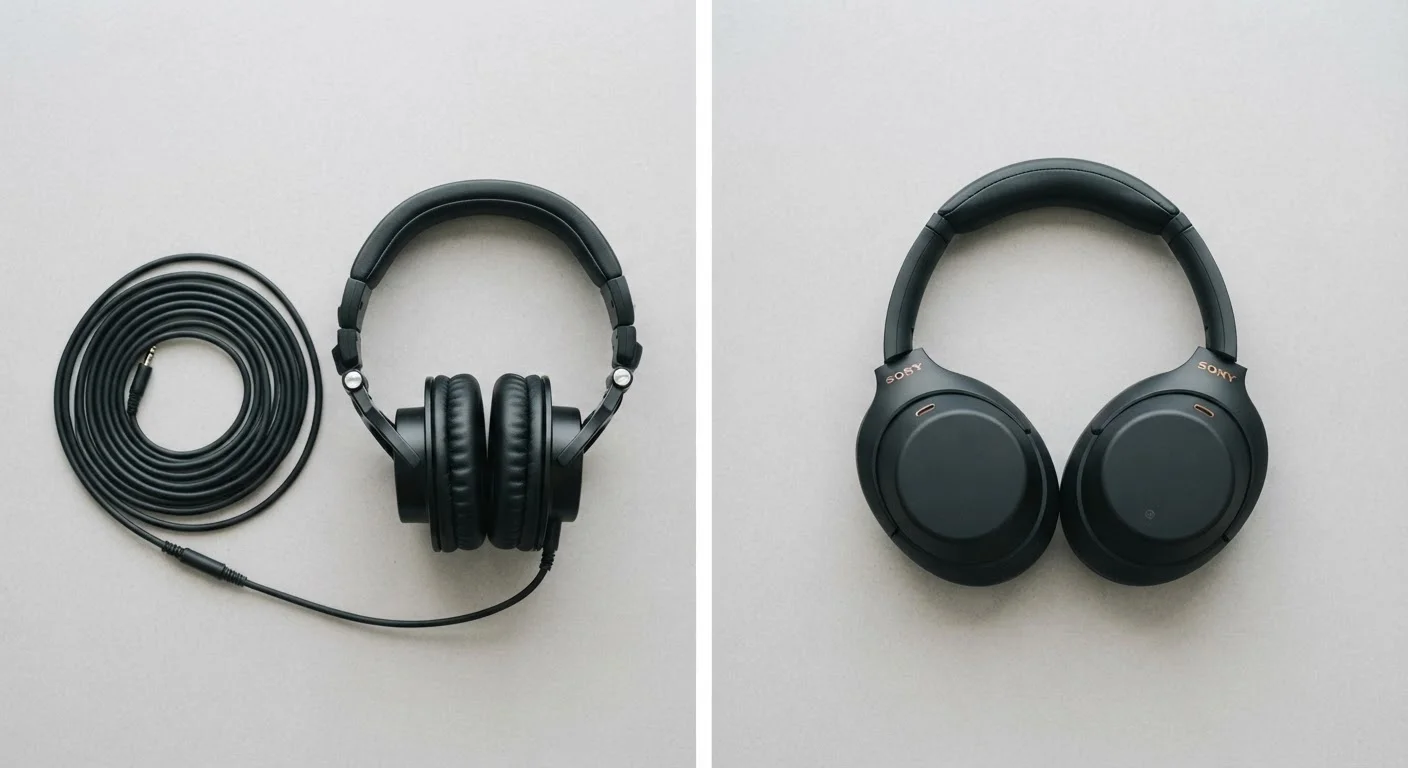
Our Verdict
Neither format wins outright - each makes real trade-offs that matter differently depending on how and where you listen. Wired headphones remain the more technically reliable choice for audio accuracy and zero-battery dependency, while wireless headphones deliver meaningful freedom of movement and modern convenience. For most people, the day-to-day practicality of going wireless will outweigh the technical advantages of a cable.
Wireless headphones suit commuters, gym-goers, and casual listeners who prioritize freedom of movement; wired headphones are the better fit for home listening, audio production work, or anyone who doesn't want to manage charging.
The Core Difference: How Each Format Delivers Sound
Wired headphones carry audio as an analog electrical signal directly from your device to the drivers in the ear cups. There's no conversion step, no radio transmission, and no compression - the signal travels in a continuous, uninterrupted stream. Wireless headphones, by contrast, receive a digital audio signal via Bluetooth, decode it, convert it to analog, and then drive the speakers. Each of those steps introduces small variables that can affect the final sound.
This doesn't automatically make wired headphones better-sounding in every situation - it means the audio path is simpler and more direct. Whether that simplicity is audible depends on the hardware quality, the source material, and, critically, the listener's ear.
What 'Lossless' Actually Means Here
Lossless audio means the audio file is transmitted without any data being discarded to reduce file size - every detail of the original recording is preserved. Standard Bluetooth codecs are lossy, meaning some data is compressed away. While aptX Lossless and Apple's lossless Bluetooth transmission are emerging options, widespread device support for fully lossless wireless audio is still limited. For most listeners, the difference is imperceptible in everyday conditions.
What You Gain With Wired Headphones
The most measurable advantage of wired headphones is latency - the delay between a sound being triggered and reaching your ears. Wired connections typically operate at near-zero latency, which matters for video editing, gaming, or playing a musical instrument through a DAW (Digital Audio Workstation). Even a few milliseconds of delay can create a noticeable disconnect between on-screen action and audio.
No battery to charge or manage
Wired headphones draw power from the source device or require none at all, meaning they're always ready to use without monitoring charge levels.
Near-zero audio latency
The direct analog signal path eliminates transmission delay, making wired headphones the reliable choice for gaming, video production, and live instrument monitoring.
Simpler, more durable long-term ownership
With no battery cell to degrade and fewer electronic components, well-made wired headphones can remain fully functional for many years.
No codec compatibility concerns
Wired connections don't depend on matching software standards between headphone and device - what you plug in is what you hear.
Wired headphones also sidestep battery dependency entirely. Plug them in and they work - no charging, no mid-session power warnings. They tend to have longer usable lifespans because there's no battery cell degrading over hundreds of charge cycles.
What You Gain With Wireless Headphones
The obvious gain is freedom of movement. Without a physical tether to your device, you can move around a room, exercise, or commute without managing a cable. Modern Bluetooth headphones often support multipoint pairing, meaning they can stay connected to two devices simultaneously - switching from a phone call to laptop audio without re-pairing.
Battery dependency limits use sessions
Wireless headphones require regular charging; running out mid-commute or mid-workout is a real inconvenience that wired users never face.
Bluetooth latency can affect video and gaming
Even with improved codecs, wireless audio can introduce perceptible delay that creates a lip-sync mismatch in video or reduces responsiveness in fast-paced games.
Battery capacity degrades over time
Lithium-ion cells in wireless headphones lose capacity after repeated charge cycles, reducing usable playback hours over the product's lifespan.
Codec mismatch can reduce audio quality
If the headphone and source device don't share a high-quality codec, the connection defaults to a lower-bitrate standard - a variable that wired connections don't have.
Active Noise Cancellation (ANC) - a feature that uses microphones to analyze and counter ambient sound - is almost exclusively found on wireless models. For open-plan offices or noisy transit, ANC can meaningfully improve focus and listening comfort.
~20-40 hrs
Typical wireless headphone battery life per charge
Battery life varies widely by model and whether Active Noise Cancellation is enabled, based on manufacturer specifications across current consumer models.
~200-300 ms
Standard Bluetooth audio latency (SBC codec)
The widely used SBC Bluetooth codec typically introduces 200-300 milliseconds of delay; newer codecs like aptX Low Latency target under 40 ms.
The Latency and Audio Quality Reality Check
Bluetooth audio codecs - the software standards used to encode and decode audio wirelessly - have improved considerably. Codecs like aptX Adaptive and LDAC are capable of transmitting higher-bitrate audio than standard Bluetooth, narrowing the quality gap with wired connections. However, both your headphone and your source device must support the same codec for it to apply; otherwise, the connection falls back to a lower-quality baseline.
For casual music streaming, podcasts, or video calls, the practical difference in audio quality between a decent pair of wired and wireless headphones is small enough that most listeners won't detect it. Where the gap becomes more apparent is in professional audio monitoring, vinyl listening setups, or high-resolution audio files - contexts where the full dynamic range matters. If you're curious about what Bluetooth actually does and doesn't do to your audio, common Bluetooth misconceptions are worth understanding before making assumptions about wireless quality.
Battery Life and Device Compatibility Considerations
Battery life on wireless headphones typically ranges from 20 to 40 hours of playback on a full charge, with significant variation based on whether ANC is enabled. Running out of battery mid-use is a real limitation that wired headphones never impose. Over time, rechargeable batteries in wireless headphones degrade - a headphone that lasts 30 hours when new may deliver noticeably less after two or three years of regular charging cycles.
Device compatibility is worth checking before choosing either format. The 3.5mm headphone jack - the standard port for wired headphones - has been removed from many modern smartphones, requiring a USB-C or Lightning adapter. Wireless headphones remove that specific friction but introduce their own: not every Bluetooth codec is supported on every device, and older Bluetooth versions may not pair reliably with newer headphones. Neither format is completely plug-and-play across all devices without some consideration.
The content on this site is for informational purposes only and is not a substitute for professional advice. Always consult a qualified professional for guidance specific to your situation.