

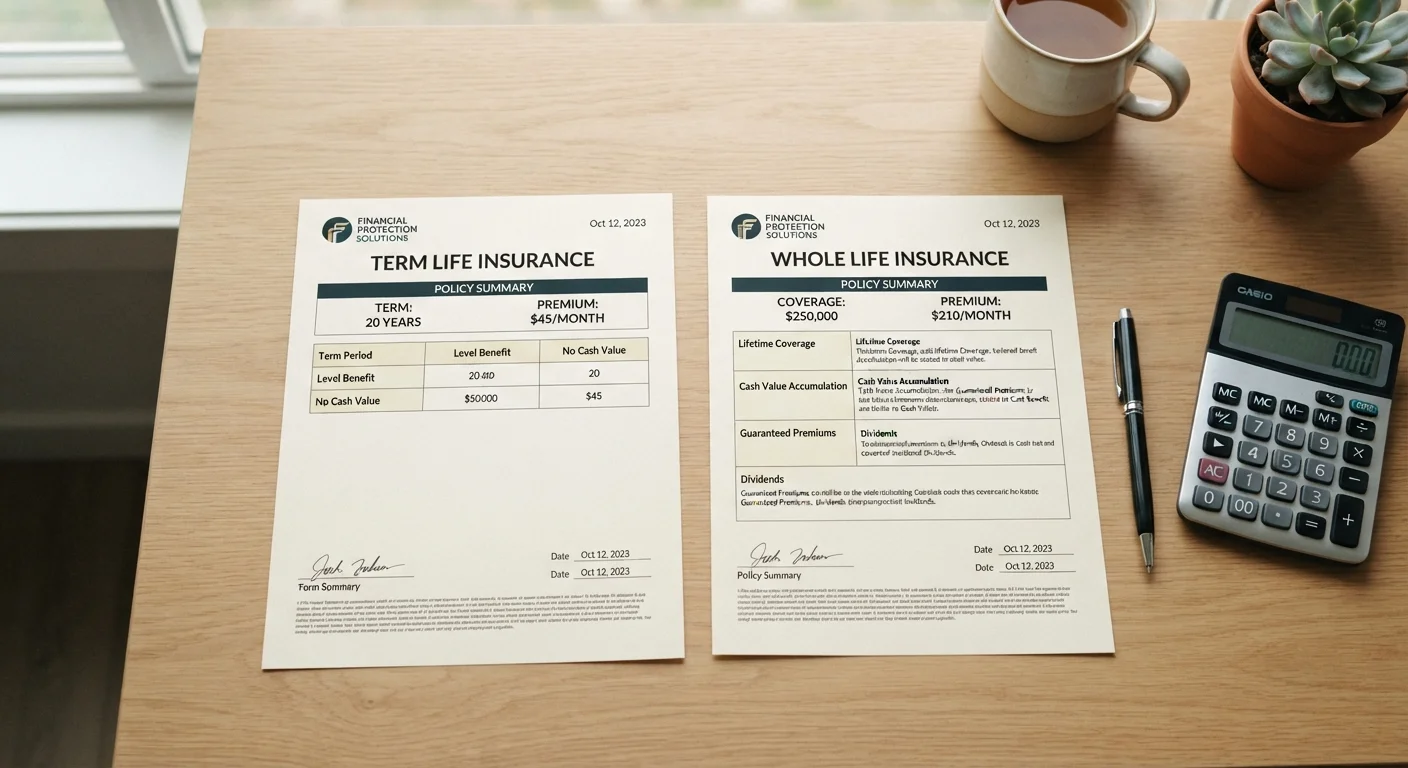
Option A
Term Life Insurance
Straightforward, affordable protection for a set period.
Best for: People who need coverage during specific high-responsibility years, such as while raising children or paying off a mortgage.
Option B
Whole Life Insurance
Permanent coverage with a built-in savings component.
Best for: People seeking lifelong coverage and a policy that builds cash value over time, typically at a higher cost.
The Core Difference: Temporary vs. Permanent
Life insurance is designed to pay a sum of money — called a death benefit — to the people you choose (your beneficiaries) when you die. Both term and whole life do that. Where they differ is how long they cover you, what you pay, and what else, if anything, the policy does.
Term life insurance covers you for a specific number of years — commonly 10, 20, or 30 years. If you die during that term, the death benefit is paid out. If the term ends and you're still alive, coverage simply stops (unless you renew or convert the policy). There's no money returned and no savings built up.
Whole life insurance covers you permanently — for your whole life — as long as you keep paying premiums. It also includes a cash value component: a portion of each premium goes into an account that grows at a guaranteed rate over time. You can borrow against that cash value, though doing so affects the death benefit if not repaid.
If you're newer to how insurance products work in general, our plain-English insurance explainer is a useful starting point before diving deeper.
| Criterion | Term Life | Whole Life |
|---|---|---|
| Coverage duration | Fixed term (e.g., 10–30 years) | Lifetime (permanent) |
| Premium cost | Generally lower | Generally higher |
| Cash value | None | Grows over time at guaranteed rate |
| Death benefit | Paid if death occurs during term | Paid whenever death occurs |
| Complexity | Simple and straightforward | More complex; multiple moving parts |
| Best budget fit | Tight or moderate budgets | Higher available premium budgets |
| Borrowing against policy | Not available | Possible against cash value |
Cost and Coverage: What You Get for Your Premium Dollar
For most people, cost is the first practical question. Term life is significantly less expensive, dollar for dollar, than whole life for the same death benefit amount. That's because term policies carry more risk for the insurer: if you die during the term, they pay. Whole life premiums are higher partly because they fund that cash value account and partly because the insurer is guaranteed to pay out eventually.
~$200/yr
Approximate average annual term life premium (healthy adult, 20-year, $250K policy)
LIMRA and industry data consistently show term life premiums are a fraction of whole life costs for comparable death benefit amounts.
54%
Share of U.S. adults with some form of life insurance
According to LIMRA's 2023 Insurance Barometer Study, just over half of American adults carry life insurance of any kind.
3–5x
Approximate cost multiple of whole life vs. term for equal coverage
Industry comparisons generally show whole life premiums running several times higher than term for the same death benefit, though actual rates vary by age and health.
The cash value in a whole life policy grows slowly, especially in the early years. Surrender charges and fees can reduce what you actually receive if you cancel the policy. It's important to understand that the cash value and the death benefit are not always additive — in many traditional whole life policies, the insurer pays one or the other, not both.
For a broader picture of which types of coverage Americans commonly carry, see The Types of Insurance Most Americans Actually Need.
When Each Type Makes Sense
Choosing between term and whole life is less about which is objectively better and more about which fits your current financial picture and long-term goals.
Term life tends to make sense if:
- You want to cover a specific financial obligation, like a 30-year mortgage or the years until your children are financially independent.
- Your budget is limited and you need the most coverage for the lowest premium.
- You prefer simplicity — you pay a premium and get a death benefit, nothing more.
Whole life may be worth exploring if:
- You want coverage that doesn't expire and don't want to worry about outliving a policy term.
- You've maxed out other tax-advantaged savings options and want to explore the cash value feature as an additional vehicle — with the understanding that returns are modest and this is not a substitute for retirement savings.
- You have a lifelong dependent, such as a child with a disability, who will always need financial support.
A Note on Policy Riders and Variations
Both term and whole life policies can include optional add-ons called riders — for example, a waiver of premium rider (waives payments if you become disabled) or a convertibility rider on a term policy (lets you convert to whole life later without a new medical exam). These features vary by insurer and affect cost. Ask any agent to explain every rider before agreeing to it.
This article provides general information about life insurance types and is not personalized financial or insurance advice. Policy terms, costs, and eligibility vary by provider and individual circumstances. Consult a licensed insurance professional or financial adviser before making any coverage decisions.
The content on this site is for informational purposes only and is not a substitute for professional advice. Always consult a qualified professional for guidance specific to your situation.