

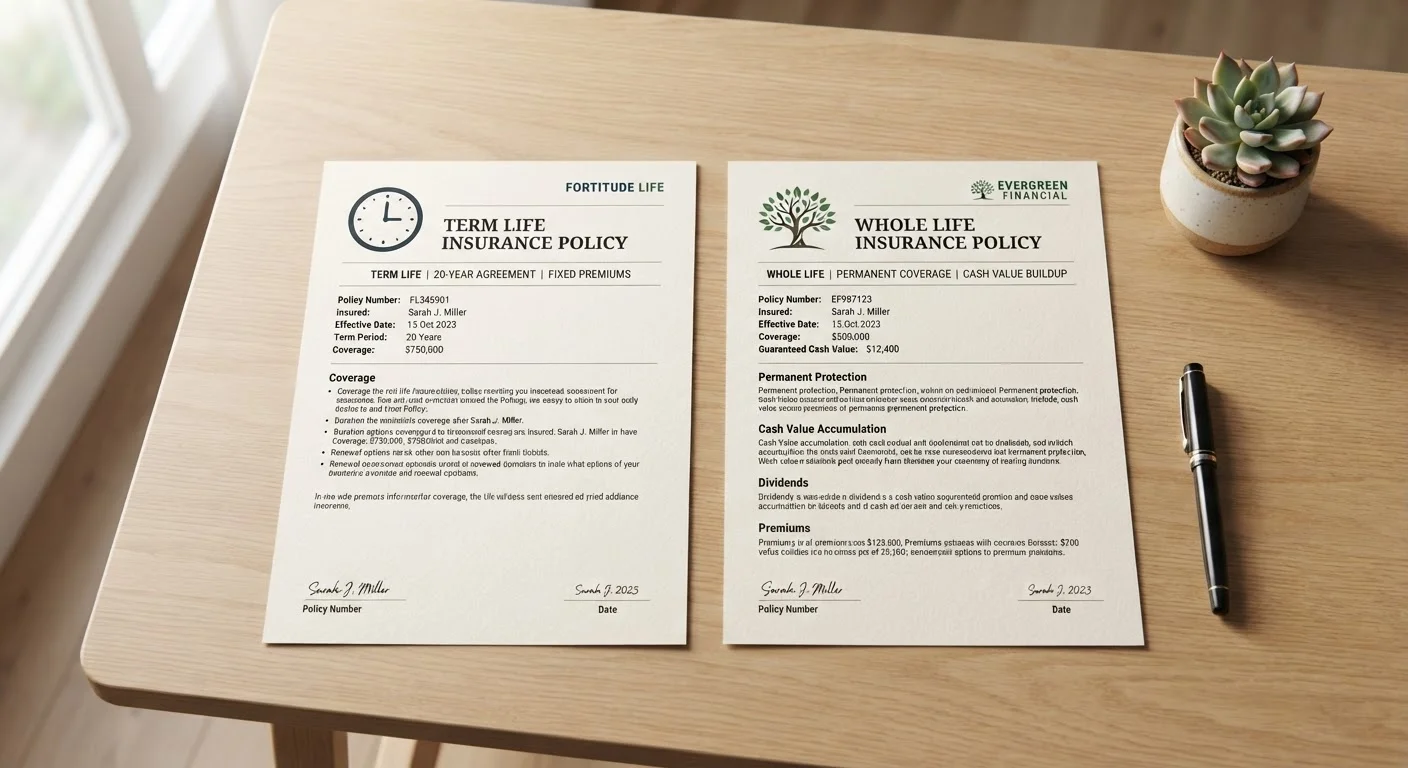
Option A
Term Life Insurance
Straightforward coverage for a defined period of time.
Best for: People who need affordable death benefit protection for a specific window - such as while raising children or paying down a mortgage.
Option B
Whole Life Insurance
Permanent coverage with a built-in savings component.
Best for: People who want lifelong coverage and are comfortable paying higher premiums for a policy that builds cash value over time.
How Each Policy Is Structured
Life insurance comes in two broad families, and the structural difference between them shapes everything - the premium you pay, how long coverage lasts, and what (if anything) the policy builds beyond a death benefit.
Term life insurance is a contract that pays a death benefit if the insured person dies within a specified period - commonly 10, 20, or 30 years. If the term ends and the policyholder is still alive, the coverage simply expires. There is no payout and no accumulated value returned. Because the insurer's risk is time-limited, premiums tend to be significantly lower than for permanent policies. For a plain-language primer on how insurance contracts work in general, see Insurance Explained: What It Is and How It Actually Works.
Whole life insurance is a form of permanent life insurance - it stays in force for the policyholder's entire life, provided premiums are paid. In addition to the death benefit, every premium payment contributes to a cash value account that grows at a guaranteed rate set by the insurer. That cash value is accessible during the policyholder's lifetime, typically through loans or withdrawals, though doing so can reduce the eventual death benefit.
| Criterion | Term Life | Whole Life |
|---|---|---|
| Coverage duration | Fixed term (e.g. 10-30 years) | Lifelong (permanent) |
| Typical premium cost | Lower | Higher |
| Cash value component | None | Yes, grows over time |
| Death benefit certainty | Only if death occurs in term | Guaranteed as long as premiums paid |
| Premium structure | Fixed for the term | Fixed for life |
| Policy complexity | Simple | More complex |
| Suitable horizon | Specific financial obligations | Long-term or estate planning needs |
The Cost Difference - and Why It Exists
Premium cost is often the first thing people notice when comparing these two policy types. A healthy 35-year-old, for example, might pay a modest monthly premium for a 20-year term policy, whereas a whole life policy with the same death benefit amount could cost several times more per month.
The gap exists for two reasons. First, term coverage is time-limited - the insurer only carries risk for the defined period, and statistically, most policyholders outlive their term. Second, whole life premiums fund both the death benefit and the cash value component, so the insurer is essentially managing an investment-like account alongside the insurance.
~80%
Term policyholders who outlive their policy
Industry observers broadly note that the large majority of term life policies never result in a claim, which is a key reason premiums can remain low.
2-3×
Typical whole life premium premium premium multiplier vs. term
Whole life premiums for equivalent death benefit amounts commonly run several times higher than term, reflecting both permanence and the cash value feature.
Neither cost profile is inherently wrong. The question is what the premium buys and whether that structure fits your financial picture. Understanding terms like premium, death benefit, and cash value clearly before buying matters - the Insurance Terms Glossary is a useful reference.
Cash Value: What It Is and What It Isn't
The cash value component of a whole life policy is often marketed as a savings or wealth-building feature. It's worth understanding what that actually means in practice.
Cash value grows slowly in the early years of a whole life policy - a larger share of early premiums goes toward insurer costs and the death benefit. Over many years, the account accumulates and can be accessed via policy loans. Interest is charged on loans, and any unpaid loan balance reduces the death benefit paid to beneficiaries.
Cash value growth is generally guaranteed at a modest rate and is tax-deferred, meaning you don't owe income tax on the growth unless you surrender the policy for more than you paid in. However, the internal costs of whole life policies mean that cash value accumulation is typically slower than investing the same dollar amount through other vehicles - a trade-off worth understanding clearly. This article provides general information only and is not personalised financial or insurance advice. Consult a licensed professional for guidance tailored to your situation.
Term life has no cash value component at all. When the term ends, the policy ends. This simplicity is by design - the product is built purely around the death benefit.
Which Situations Each Policy Tends to Suit
Most financial educators describe term life as better suited to people with a specific, time-bound coverage need - protecting dependents during working years, covering a mortgage balance, or replacing income while children are young. Once those obligations are met, the coverage can end.
Whole life is often discussed in the context of estate planning, covering final expenses with certainty, or situations where a permanent death benefit matters regardless of when death occurs. Its higher cost reflects that it's designed to pay out eventually, not just during a risk window.
It's worth noting that some people start with term coverage and later evaluate whether a permanent policy makes sense - a decision best made with the input of a licensed insurance agent or financial adviser who can review your full picture. For a broader overview of the insurance landscape, The Main Types of Insurance and What Each One Covers puts life insurance in context alongside other common policy types.
This article is for general informational and educational purposes only. It is not personalised insurance, financial, or legal advice. Coverage terms, premiums, and eligibility vary by insurer and individual circumstances. Always read policy documents carefully and consult a licensed insurance professional before making coverage decisions.
The content on this site is for informational purposes only and is not a substitute for professional advice. Always consult a qualified professional for guidance specific to your situation.