

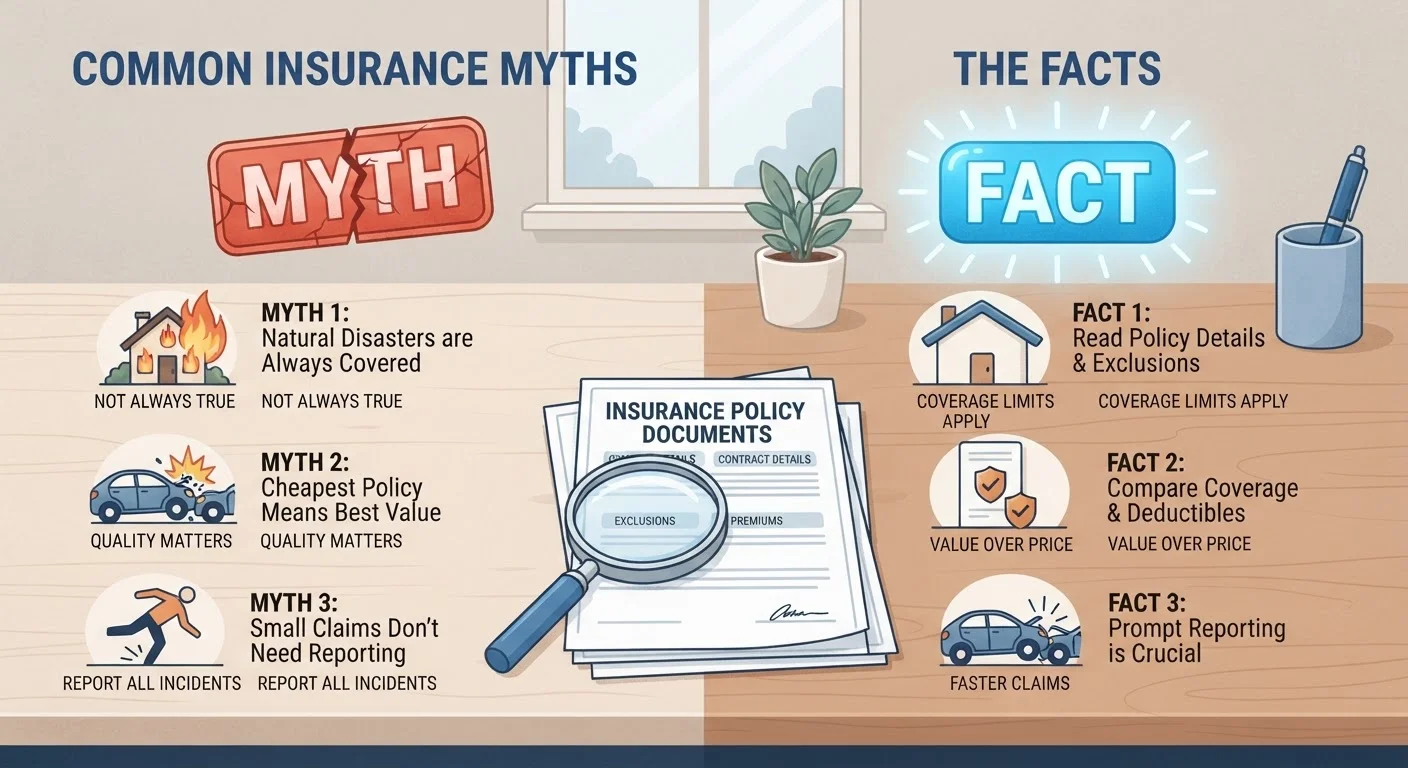
Why Insurance Myths Persist - and What They Cost You
Insurance is complicated enough that most people rely on secondhand knowledge - what a friend said, something half-remembered from years ago, or a general impression of how coverage works. That's understandable. But acting on inaccurate assumptions about insurance can mean paying for coverage that doesn't match your actual risks, or worse, discovering too late that a gap exists.
The myths below are some of the most common - and most consequential - circulating among US consumers. Each one is corrected with the more accurate picture, drawn from general insurance principles. For a foundational understanding of how policies actually function, our insurance explainer is a useful starting point.
Myth
Red cars cost more to insure because insurers charge a premium for the color.
Fact
Insurers do not factor vehicle color into premium calculations. What matters is the make, model, year, engine size, safety record, and your personal driving history.
The red-car myth is one of the most persistent in personal finance, but there is no credible evidence that color appears anywhere in standard underwriting models. Insurers focus on risk factors tied to the vehicle itself and the driver - including claims history, mileage, and how the car is used. Understanding what actually drives your premium is explained further in our article on how insurers calculate your premium.
Myth
My landlord's insurance covers my belongings if something goes wrong in my rental.
Fact
A landlord's policy covers the building structure and the landlord's liability - not a tenant's personal possessions or personal liability.
If a fire, theft, or water leak damages your furniture, electronics, or clothing in a rental property, your landlord's policy will not reimburse you. Renters insurance - a separate, generally affordable policy - is designed specifically to cover tenants' personal property and provide liability protection. Many renters go without it simply because they assume the landlord's coverage extends to them. It does not. For a broader look at how insurance works, see our plain-language insurance explainer.
Myth
Carrying the minimum legally required auto insurance is enough protection.
Fact
Minimum coverage satisfies legal requirements but often leaves substantial gaps - particularly for medical bills, property damage above the liability limit, and damage to your own vehicle.
State minimum auto insurance requirements are set as a legal floor, not as a financial safety net. In a serious accident, medical costs and vehicle repairs can exceed minimum liability limits quickly, leaving you personally responsible for the difference. Collision and comprehensive coverage, uninsured motorist protection, and higher liability limits exist precisely because minimums frequently fall short. A licensed agent can help you assess what level of coverage fits your actual situation.
Myth
Life insurance is only worth having if you have dependents.
Fact
While dependents are the most common reason to carry life insurance, other obligations - co-signed debt, business partnerships, or covering end-of-life costs - can also make life insurance relevant for people without children.
If you have a co-signed loan, a business partner, or family members who would face funeral and estate costs, life insurance may serve a practical purpose beyond income replacement for children. That said, life insurance needs are genuinely individual. Blanket rules in either direction - 'everyone needs it' or 'only parents need it' - tend to oversimplify. Consulting a licensed financial adviser or insurance professional is the most reliable way to assess your own position.
Myth
Health insurance covers everything once you've hit your deductible.
Fact
After meeting your deductible, you typically still pay a share of costs through coinsurance or copays until you reach your out-of-pocket maximum. And some services may not be covered at all.
Many people assume that once the deductible is paid, their insurer takes over completely. In most US health plans, cost-sharing continues through coinsurance (a percentage of each bill) until the out-of-pocket maximum is reached. Beyond that, coverage exclusions - for certain treatments, providers outside the network, or specific categories of care - may mean some costs are never covered regardless of how much you have spent. Reading the Summary of Benefits and Coverage document for your specific plan is essential.
Misconceptions at Claim Time Can Be the Most Damaging
Many of the assumptions above only become obvious problems when someone files a claim and discovers the reality doesn't match expectations. At that point, the options are limited and the costs can be significant.
Your Policy Documents Are the Final Word
No general article - including this one - can tell you exactly what your policy covers. Coverage terms, exclusions, and limits vary significantly between insurers and individual policies. Always read your policy documents in full, and speak with a licensed insurance agent or adviser when making decisions about your own coverage.
Small misunderstandings - like not disclosing a home office, undervaluing possessions, or missing a renewal change - can compound these gaps further. Our article on insurance mistakes that affect claims walks through specific oversights worth knowing about before a claim arises, not after.
Assuming Coverage Exists Can Be Costly
Many claim disputes arise not from insurer bad faith but from policyholders genuinely misunderstanding what they signed up for. Assuming you are covered - without verifying - can result in out-of-pocket costs far larger than the premium savings you thought you were getting. Verify coverage before you need it, not after.
If you're unsure whether your current coverage reflects your actual needs, a conversation with a licensed insurance agent is a straightforward next step. Coverage decisions are personal and depend on your specific situation - general information like this article is a starting point, not a substitute for professional guidance.
This article is for general informational purposes only and does not constitute personalised insurance, financial, or legal advice. Coverage terms, exclusions, and costs vary by provider and individual circumstances. Consult a licensed insurance agent or financial adviser before making decisions about your own coverage.
The content on this site is for informational purposes only and is not a substitute for professional advice. Always consult a qualified professional for guidance specific to your situation.