

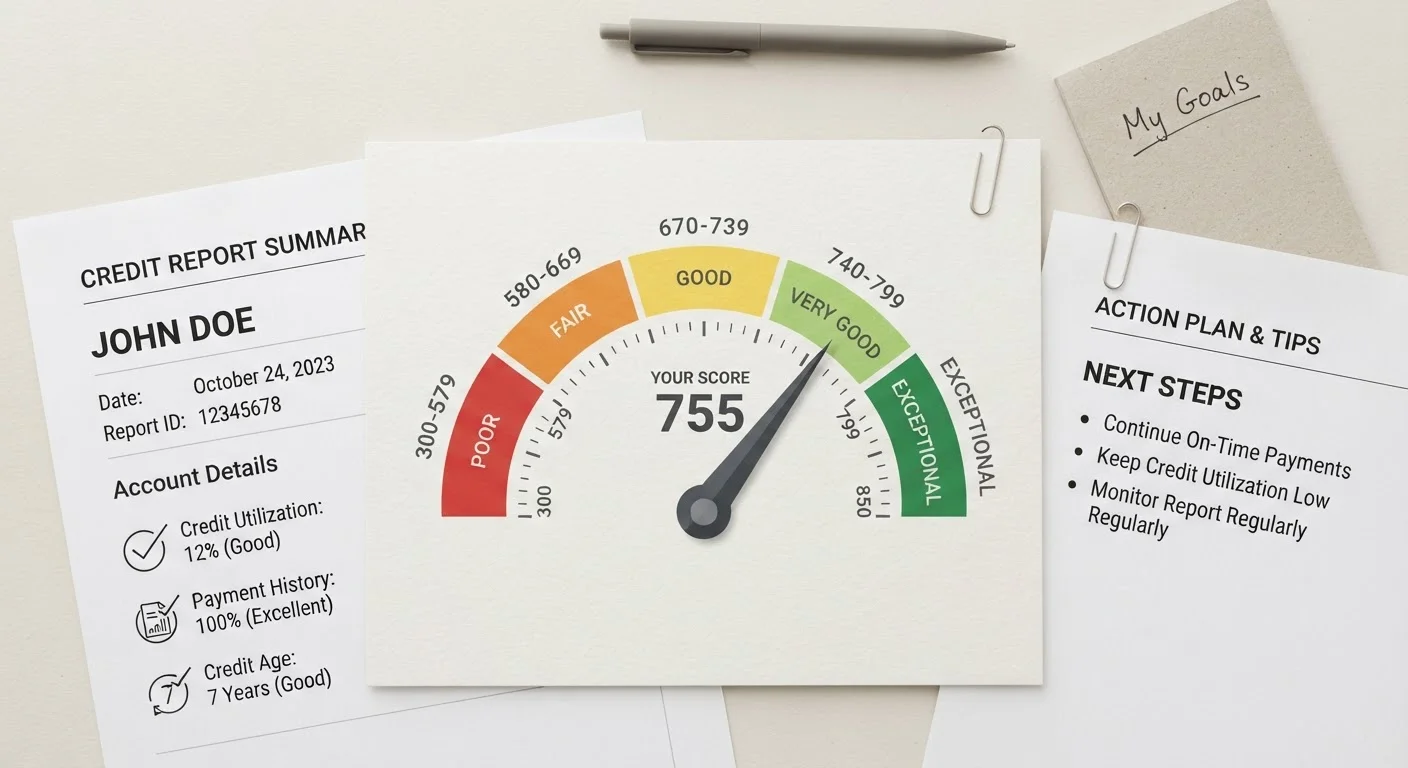
What Goes Into a Credit Score?
Most credit scores used by U.S. lenders - including the widely referenced FICO® Score - are calculated using five categories of information pulled from your credit report. Each category carries a different weight, so understanding the breakdown tells you exactly where to focus your energy.
If you're new to how credit works overall, our introduction to credit and debt covers the full foundation. This article zeroes in on the five scoring factors specifically.
| Payment History Weight | 35% (FICO® Score methodology) |
| Amounts Owed (Utilisation) Weight | 30% (FICO® Score methodology) |
| Length of Credit History Weight | 15% (FICO® Score methodology) |
| Credit Mix Weight | 10% (FICO® Score methodology) |
| New Credit (Inquiries) Weight | 10% (FICO® Score methodology) |
| Score Range (FICO®) | 300-850 |
The Five Factors, Explained
1. Payment History - 35%
This is the single largest factor. Lenders want to know whether you pay on time, every time. Late payments, accounts sent to collections, bankruptcies, and charge-offs all leave marks here. Even one 30-day late payment can noticeably lower your score, and the damage lingers - though it fades over time as you build a clean track record.
2. Amounts Owed (Credit Utilisation) - 30%
This measures how much of your available revolving credit you're currently using. If your combined credit card limits total $10,000 and your balances total $3,000, your utilisation is 30%. Scoring models generally reward keeping that ratio low - many guidelines suggest staying under 30%, with lower being better. Our article on credit utilisation goes deeper on how this ratio is calculated across individual cards and your total credit profile.
3. Length of Credit History - 15%
Longer histories give lenders more data to assess. This factor looks at the age of your oldest account, your newest account, and the average age of all your accounts. Closing an old card can shorten your average history and may lower your score, which is worth knowing before you cancel something.
4. Credit Mix - 10%
Having experience with different types of credit - revolving accounts like credit cards and installment loans like auto or student loans - can work in your favor. This factor reflects whether you can manage varied credit responsibly. That said, opening accounts just to diversify your mix rarely makes financial sense.
5. New Credit (Recent Inquiries) - 10%
Each time you apply for new credit, the lender typically performs a hard inquiry, which can temporarily dip your score by a few points. Multiple applications in a short window raise a flag for lenders - it can suggest financial stress. Rate-shopping for a mortgage or auto loan is usually treated more leniently; scoring models often group multiple inquiries for the same loan type within a short period as a single event.
How to Use This Knowledge Practically
Because payment history and utilisation together account for roughly 65% of a typical score, they're the highest-leverage places to start. Paying every bill on time - even the minimum when cash is tight - protects your most valuable scoring factor. Paying down revolving balances improves your utilisation relatively quickly, since balances are reported monthly.
Length of history and credit mix generally improve on their own with time and normal use. New credit inquiries are minor and short-lived, so don't let fear of a small temporary dip stop you from applying for credit you genuinely need.
To see exactly which accounts and inquiries are currently on your file, walk through reading your credit report for the first time. Understanding what's already there is a practical first step before trying to change your score.
This article is for general informational purposes only and does not constitute personalised financial or credit advice. For guidance specific to your situation, consider speaking with a licensed financial adviser or credit counselor.
The content on this site is for informational purposes only and is not a substitute for professional advice. Always consult a qualified professional for guidance specific to your situation.