

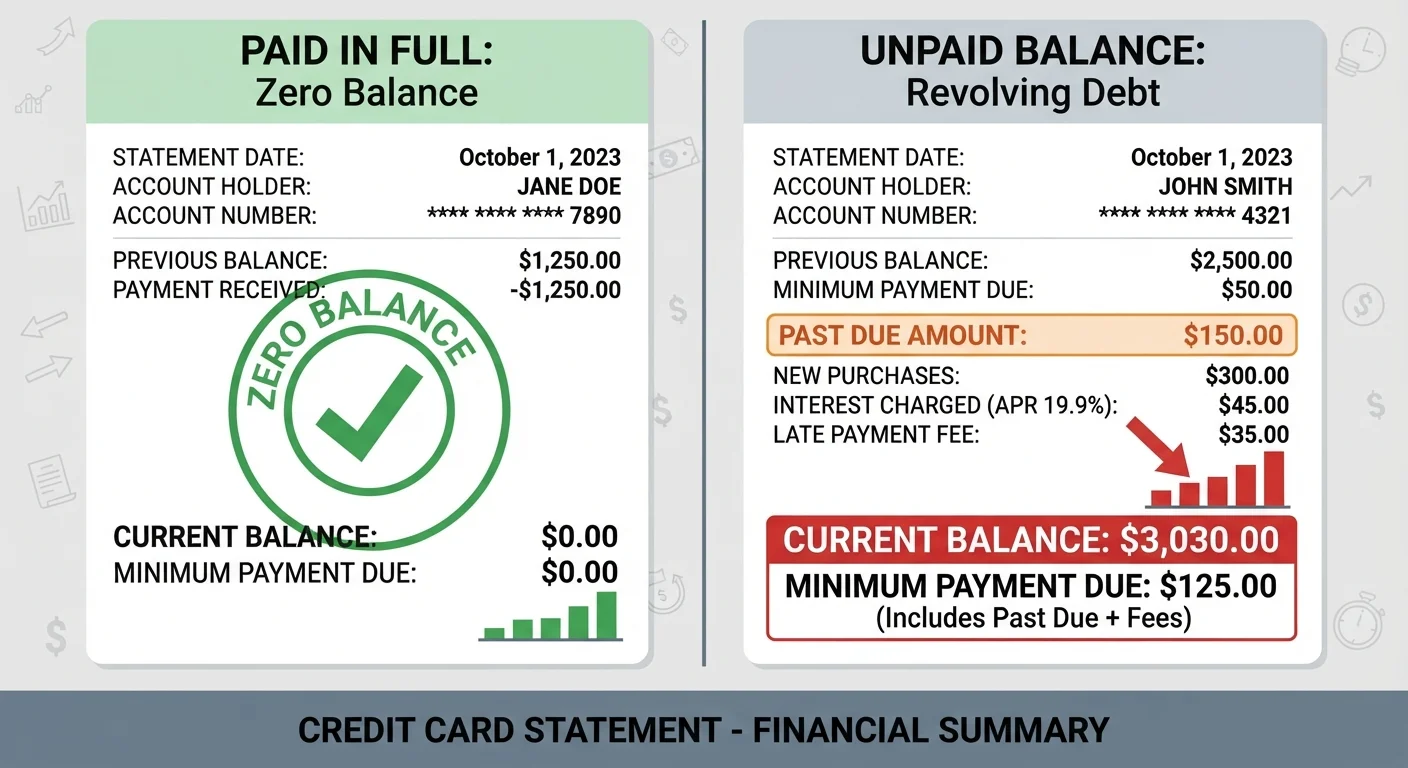
Our Verdict
For most cardholders, paying the full statement balance every billing cycle is the financially sound default: it eliminates interest charges, protects your credit profile, and keeps your cash flow predictable. Carrying a balance costs money every single month and offers no credit-score benefit over paying in full. If you're already revolving debt, understanding how interest accrues - and having a clear payoff plan - is the most important next step.
| Best for | Recommended |
|---|---|
| Everyday cardholders who can cover their full statement balance | Paying in Full |
| Those managing a short-term cash flow gap with a clear payoff timeline | Carrying a Balance (temporarily) |
| Anyone trying to minimize total interest paid over time | Paying in Full |
What 'Carrying a Balance' Actually Means
When you carry a balance, you're leaving some or all of your credit card statement unpaid at the end of a billing cycle. The remaining amount rolls over to the next month - and the card issuer begins charging interest on it.
Interest on revolving credit card debt is typically calculated using your average daily balance, which means the charge isn't just applied once at month's end. It accrues every single day. How interest compounds on revolving debt explains this in detail, but the short version is: even a moderate balance at a common APR can generate a surprising amount in interest over just a few months.
One persistent myth worth dispelling: carrying a balance does not help your credit score. There is no scoring benefit to revolving debt from month to month. That idea may have originated from misunderstanding how credit activity is reported - but creditors simply report whether you have a balance, not whether you "used" the card in a way that builds history.
What Paying in Full Each Month Gets You
Paying the full statement balance by the due date every cycle means you never enter the interest calculation at all. Most card issuers extend a grace period - typically 21 to 25 days after the billing cycle closes - during which no interest is charged on new purchases, as long as the previous balance was cleared. That grace period disappears once you start carrying a balance.
Beyond avoiding interest, paying in full supports a lower credit utilization ratio - the percentage of your total available credit that's in use. Credit scoring models generally treat lower utilization more favorably. If you regularly pay your balance before or at the statement date, your reported utilization stays low even if you charge frequently. See habits that support a healthy credit profile for how payment behavior fits into your broader credit picture.
| Carrying a Balance | Paying in Full | |
|---|---|---|
| Interest charges | Yes - accrues daily on unpaid amount | None - grace period applies |
| Credit score impact | Higher utilization if balance is large | Lower utilization, generally favorable |
| Grace period on new purchases | Usually lost while balance remains | Preserved each billing cycle |
| Monthly cash flow required | Only minimum payment required | Full statement balance due |
| Total cost over time | Higher - interest compounds | Lower - no added cost |
| Risk of debt escalation | Real if minimums only are paid | Minimal with disciplined spending |
When Carrying a Balance Might Be Unavoidable
There are circumstances where carrying a balance is a practical reality rather than a choice - an unexpected expense, a gap between paychecks, or a period of reduced income. That's worth acknowledging without judgment.
If you're in that situation, a few things matter most:
- Pay more than the minimum. Minimum payments are structured to extend your repayment over a very long period. Paying only the minimum on a $2,000 balance at a typical APR could take years to eliminate and cost hundreds of dollars in interest.
- Have a payoff target. Even a rough plan - pay an extra $50 a month, or clear it within six months - reduces total interest paid and gives you a clear exit.
- Avoid adding to the balance. Each new charge on a balance-carrying card likely loses its grace period, so new purchases start accruing interest almost immediately.
If you're weighing taking on additional credit while already carrying debt, this personal finance checklist can help you pressure-test that decision.
The Credit Score Angle: What Actually Matters
Both approaches affect your credit profile, but not always in the ways people assume. Here's what the scoring factors actually respond to:
- Payment history - the largest factor in most scoring models - simply asks: did you pay at least the minimum by the due date? Paying in full satisfies this. So does a minimum payment. But missed or late payments damage your score significantly under either approach.
- Credit utilization is where the two strategies diverge more clearly. A large revolving balance raises your utilization ratio, which can pull your score down. Paying in full - or paying down a carried balance before the statement closes - keeps utilization low.
If you're also thinking about how account age and available credit interact with these decisions, why closing old credit cards can hurt you is a useful companion read.
For a foundational overview of how credit scoring works end to end, understanding credit and debt from the ground up is a solid starting point.
This article is for general informational purposes only and does not constitute personalized financial or credit advice. Consult a licensed financial professional for guidance specific to your situation.
The content on this site is for informational purposes only and is not a substitute for professional advice. Always consult a qualified professional for guidance specific to your situation.