

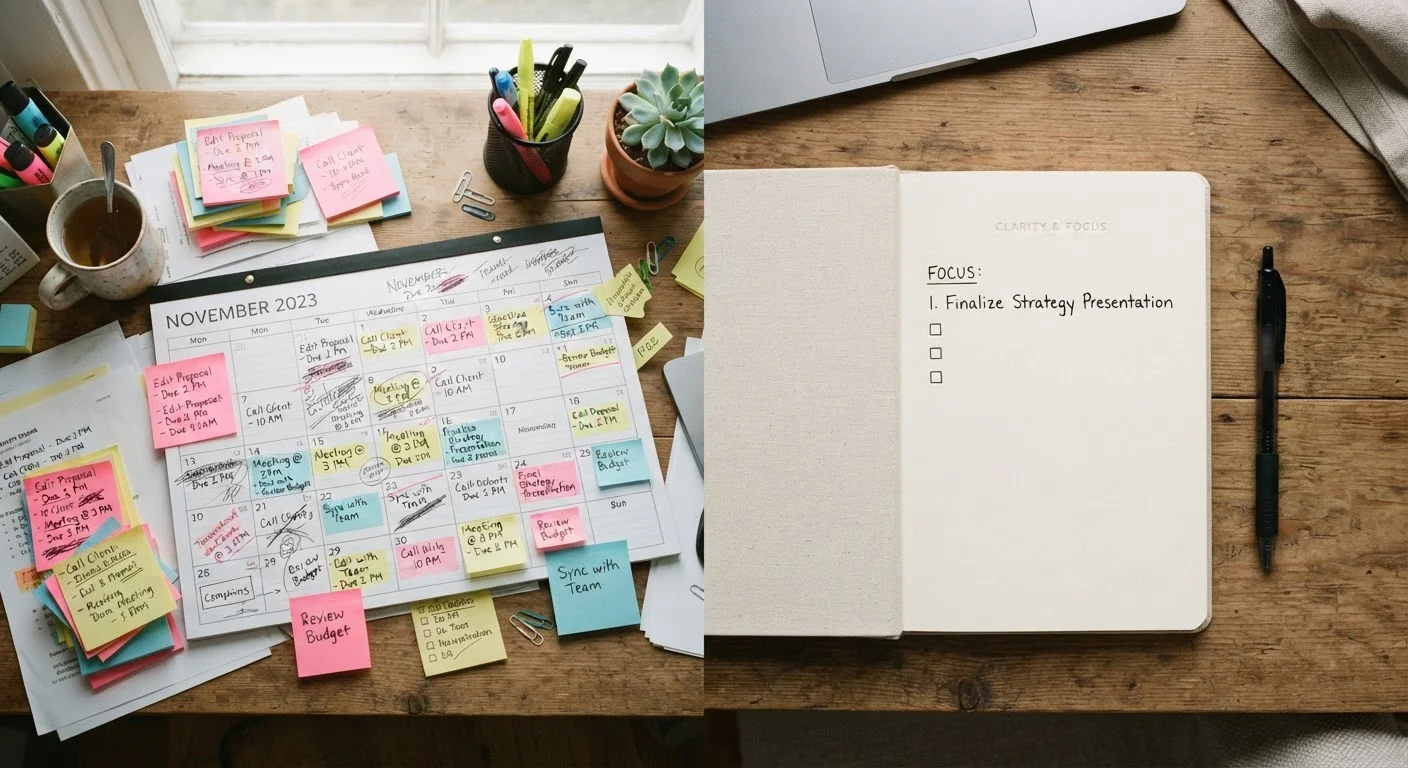
Why the Distinction Matters at Work
Most workplaces reward the appearance of effort. Arriving early, staying late, keeping your calendar packed — these are visible signals that get noticed. But visibility and value are not the same thing.
When you confuse being busy with being productive, you end up optimizing for the wrong metric. You clear your inbox instead of finishing the proposal. You join every meeting instead of protecting time for deep work. At the end of the week, you're exhausted — and the work that actually matters has barely moved.
This confusion also accumulates. Over time, chronic busyness can contribute to cognitive overload. If you've noticed a sense of constant motion without real progress, your mental load may be heavier than you realize — a pattern worth taking seriously.
~28%
Workday spent on email by average employee
McKinsey research has found that knowledge workers spend roughly 28% of their workweek reading and responding to email — time that often displaces higher-value tasks.
23 min
Average time to refocus after an interruption
Research from the University of California, Irvine found it takes an average of 23 minutes to fully regain focus after a workplace interruption — highlighting the cost of reactive work habits.
What Busyness Looks Like in Practice
Busyness has a few reliable tell-tale patterns:
- Reactive task management: You work through your inbox chronologically rather than by importance, letting other people's urgencies set your priorities.
- Meeting accumulation: Your calendar fills up with recurring check-ins that could have been an email, leaving no uninterrupted time for focused work.
- To-do list inflation: You add quick, easy tasks to your list specifically because they're satisfying to cross off — not because they're important.
- Perpetual availability: You respond to every message immediately, training others to expect instant replies and fragmenting your own concentration.
None of these behaviors are inherently bad — they become problematic when they crowd out the work that produces real results. This same dynamic appears in job searching: applying to dozens of jobs at once often produces zero results, because volume without strategy is just busyness in a different setting.
How to Shift Toward Genuine Productivity
Productivity isn't about doing more — it's about doing the right things with the focus they deserve. Here's how to start making that shift:
Identify your highest-impact tasks
Each day, ask: If I only completed one thing today, what would have the greatest positive effect on my goals? That task gets protected time — ideally scheduled during your peak energy hours, not squeezed in between meetings.
Audit how you spend your time
Track your actual activities for two or three days without changing anything. Most people are surprised by how much time disappears into low-value work. Awareness is the first step to change.
Learn to say no strategically
Declining a meeting or request isn't laziness — it's protecting your capacity for work that matters. If you struggle with prioritization under pressure, prioritizing tasks when everything feels urgent offers a practical framework for those moments.
Match your system to how you actually work
Rigid time-blocking doesn't work for everyone. Time management approaches for people who dislike rigid schedules explores alternatives that fit different working styles.
Try the 'One Thing' Rule Each Morning
Before opening email or checking messages, write down the single most important task for the day. Commit to finishing it — or making substantial progress — before switching to reactive work. This one habit consistently redirects effort from busyness to results.
The Role of Rest in Sustaining Productivity
One of the counterintuitive truths about productivity is that protecting downtime is part of the strategy. Sustained busyness degrades decision-making, reduces creative thinking, and makes prioritization harder — the exact skills you need to stay productive.
This doesn't mean being idle. It means understanding that doing less can build more — a principle that applies to cognitive work just as much as physical training. Scheduled breaks, clear end-of-day boundaries, and not checking messages outside work hours are productivity habits, not indulgences.
The goal isn't a perfectly efficient machine — it's a sustainable rhythm where your most important work consistently gets your best attention.
“Being busy is most often used as a guise for avoiding the few critically important but uncomfortable actions that make all the difference.”
— Tim Ferriss, Author and entrepreneur known for writing on productivity and work design
Frequently Asked Questions
Yes, but it's less common than people assume. You can be productive during a busy period if most of your activity is aligned with meaningful goals. The problem arises when busyness crowds out the time and focus needed for your highest-value work.
Ask yourself: at the end of the day, did you move your most important goal forward? If your answer is mostly 'I responded to a lot of messages' or 'I was in meetings,' that's a busyness signal. Productive days feel directional — you can name what you actually accomplished.
Activity triggers a sense of effort and momentum, which the brain rewards. Checking items off a to-do list releases a small dopamine hit regardless of those items' actual importance. This makes low-value tasks feel satisfying in the moment.
There are periods — project launches, deadlines — where high activity volume is genuinely necessary. The issue is treating that peak state as the default mode rather than a temporary sprint. Sustained busyness without recovery or prioritization tends to decrease quality over time.
Before you start work, write down the one task that would make the biggest difference if completed today. Protect time to finish that task before turning to email, meetings, or requests. That single habit reorients your day around impact rather than reactivity.
The content on this site is for informational purposes only and is not a substitute for professional advice. Always consult a qualified professional for guidance specific to your situation.