

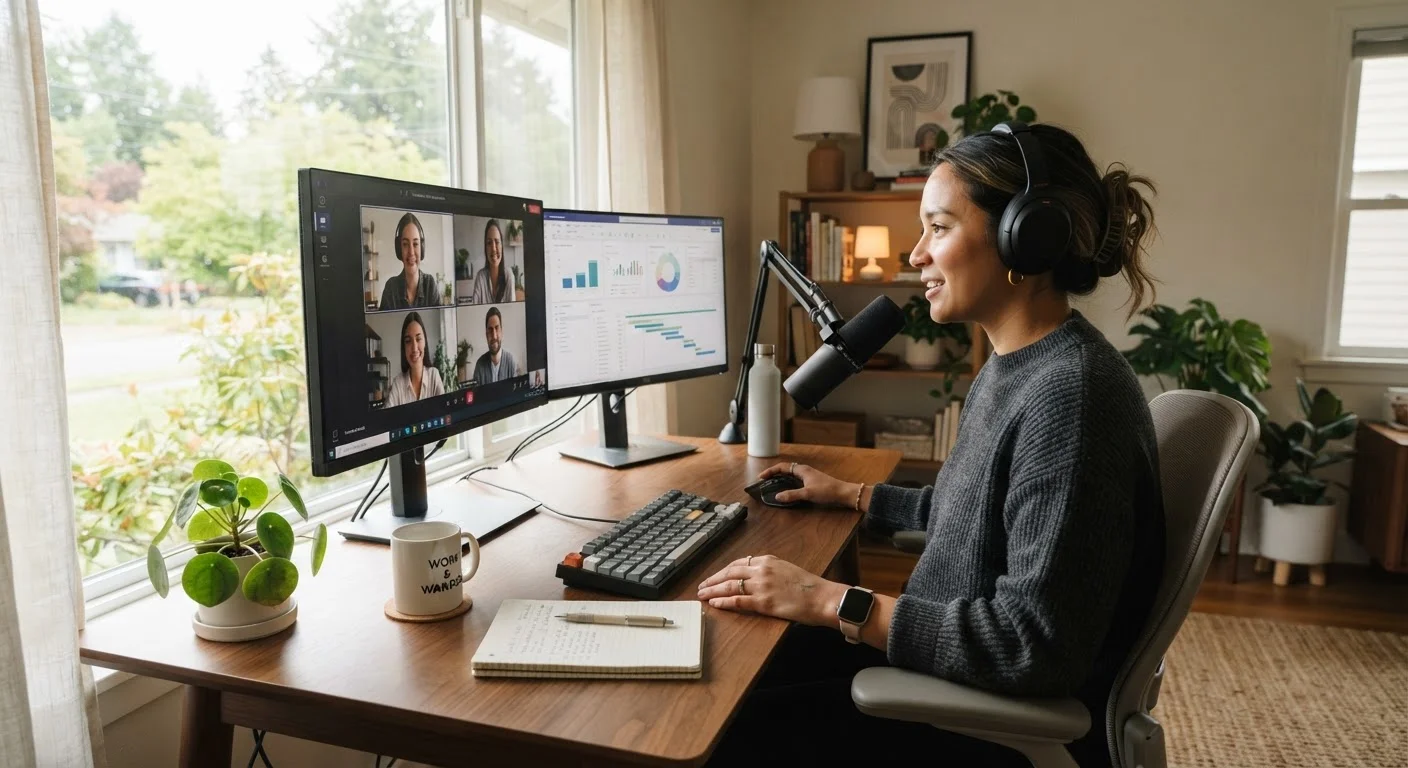
Why Remote and Hybrid Work Needs a Different Skill Set
Working outside a shared office isn't just a location change — it fundamentally shifts how you communicate, stay accountable, and build credibility with colleagues and managers. Many of the informal cues workers relied on in person (a quick desk chat, visible effort, body language) simply don't translate. That gap has to be filled deliberately.
The good news is that these skills can be learned. They're not personality traits you either have or don't. They're habits and practices that, once identified, can be developed with consistent effort. Whether you're fully remote or splitting time between home and an office, the skills below have a measurable impact on how well you perform and how you're perceived. For a broader look at how the job market now weights these abilities, see how today's job market has shifted.
Written communication clarity
In a remote setup, most of your communication happens in writing — via email, chat platforms, or project management tools. Unclear messages create bottlenecks and misunderstandings that take longer to resolve without the option of a quick in-person follow-up.
Strong written communication means being concise without being curt, providing enough context so recipients don't need to ask follow-up questions, and knowing when a quick message is appropriate versus when a longer, structured update is warranted. It also includes proofreading before sending and adapting tone to audience — a message to a direct report reads differently from one to a senior stakeholder.
Clear writing replaces the informal cues that in-person offices provide automatically.
Self-directed time management
Without a commute, a set desk, or a manager physically nearby, the structure of your workday becomes your own responsibility. Workers who thrive remotely tend to build their own systems: designated work hours, task prioritization routines, and clear signals to themselves (and others at home) for when they're working versus off.
This doesn't mean rigid scheduling. It means understanding how you work best — when your focus peaks, how long you can sustain deep work, and how to protect time for important tasks rather than letting reactive work (notifications, requests) fill every hour.
Remote workers who define their own structure consistently outperform those who react to whatever appears first.
Digital tool fluency
Most remote and hybrid roles run on a stack of software: video conferencing, messaging apps, shared document platforms, project trackers, and sometimes industry-specific tools. Being comfortable navigating these — and learning new ones quickly — reduces friction for everyone you work with.
Fluency doesn't mean being a power user of every platform. It means knowing the basics reliably, understanding the etiquette each tool implies (a message on a chat app suggests urgency; a shared doc comment doesn't), and being able to troubleshoot common issues independently without derailing meetings or deadlines.
Tool fluency isn't about using every feature — it's about not making digital friction everyone else's problem.
Proactive relationship-building
In an office, relationships form partly through proximity — shared lunches, hallway conversations, overhearing context. Remote workers don't get that by default. Visibility and trust have to be built on purpose.
This means checking in with colleagues without always needing an agenda, participating actively in team meetings rather than going on mute and multitasking, and making sure your contributions are documented and visible rather than assumed. It also means seeking out mentors or peers intentionally, since the organic mentorship that often happens in offices is far less common at a distance. Adaptability at work covers related territory on sustaining performance through shifting conditions.
Trust with remote colleagues doesn't accumulate passively — it requires consistent, visible effort.
Comfort with ambiguity and independent judgment
Remote environments often mean fewer real-time check-ins and more situations where you have to make a reasonable call without immediate guidance. Workers who need frequent reassurance can struggle; workers who can assess a situation, make a defensible decision, and move forward — then communicate what they did — are far more effective.
This skill overlaps with what's sometimes called autonomous working: the ability to manage your own workload and problem-solve without constant escalation. It doesn't mean ignoring when guidance is genuinely needed. It means developing enough professional judgment to know the difference.
Knowing when to decide independently and when to escalate is one of the most underrated remote work skills.
Intentional availability — not constant availability
A common misconception about remote work is that being always online signals dedication. In practice, constant availability often degrades focus, increases burnout risk, and trains colleagues to expect immediate responses regardless of complexity. Strong remote workers set and communicate their availability — response time norms, focus hours, and offline windows — and stick to them consistently.
This skill also involves recognizing when asynchronous communication is fine (most of the time) versus when a live conversation is genuinely faster and clearer. Defaulting to video calls for everything wastes time; defaulting to async for nuanced discussions creates confusion. Calibrating that judgment is a practical skill worth developing. See the full workplace skills overview for more on how these abilities connect.
Sustainable remote work means protecting focus time, not simply staying logged on longer.
Building These Skills Takes Consistency, Not a Crash Course
None of these skills develop overnight, and no single tool or tactic covers all of them. What they share is that they all require intentional practice — setting up systems, reflecting on what's working, and adjusting. Workers who treat remote or hybrid work as a temporary situation they're just surviving tend to develop fewer of these habits. Those who treat it as a permanent mode worth investing in tend to advance.
Start with one skill, not six
Trying to develop every skill on this list at once is a reliable way to improve none of them. Pick the area where the gap is most obvious in your current role — most workers know intuitively which one that is. Build a specific habit around it for four to six weeks before moving to the next. Small, sustained changes produce more durable results than broad attempts at self-overhaul.
These skills also overlap significantly with what drives long-term career growth more broadly. If you want to understand how they fit into a bigger picture, skills that separate stalled careers from growing ones is worth reading alongside this article. And for a grounding in how soft and hard skills interact in employer expectations, see our overview of soft skills vs. hard skills.
The content on this site is for informational purposes only and is not a substitute for professional advice. Always consult a qualified professional for guidance specific to your situation.