

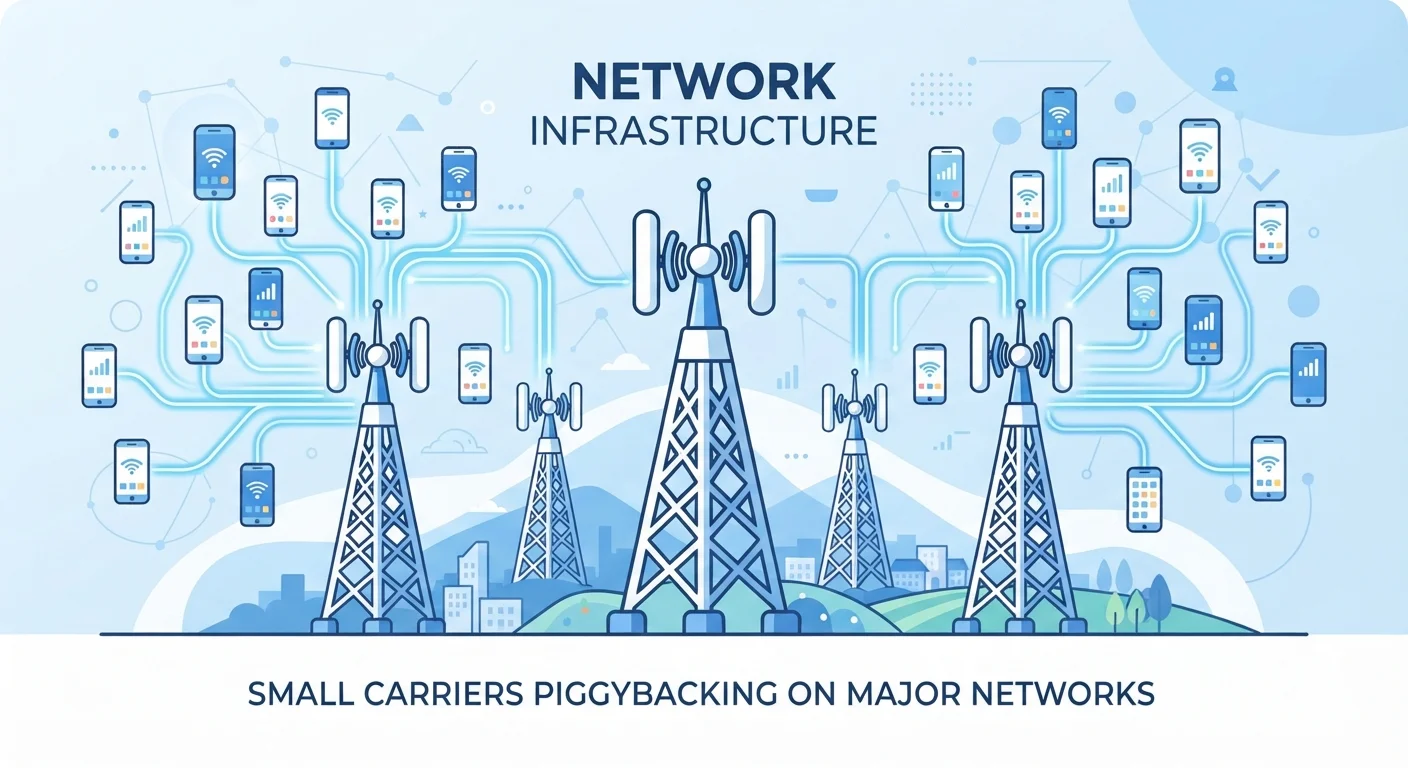
How MVNOs Actually Work
Think of an MVNO like a store-brand product on a supermarket shelf. The store didn't manufacture the product — a third-party factory did — but the store packages and sells it under its own label, often at a lower price. MVNOs operate the same way with mobile service.
A major carrier — called the host network or MNO (Mobile Network Operator) — builds and maintains the physical infrastructure: towers, spectrum licenses, and fiber backhaul. The MVNO negotiates a wholesale deal to buy blocks of that capacity, then resells it to everyday consumers. The MVNO handles its own branding, pricing, customer support, and billing, but it never touches a tower.
Because several MVNOs can ride the same host network simultaneously, you may find that two very different-looking brands actually deliver service through the exact same physical infrastructure. Understanding which major network an MVNO partners with is one of the most important checks you can do before signing up. See our glossary of mobile plan terms to decode the jargon you'll encounter while comparing options.
~40%
US adults who have considered switching to a smaller carrier
Industry surveys consistently find a large share of consumers are open to MVNO options when they become aware of the cost differences.
3
Major US host networks MVNOs partner with
Nearly all US MVNOs operate on AT&T, T-Mobile, or Verizon's infrastructure, meaning coverage quality maps closely to one of these three networks.
No contract
Typical MVNO commitment structure
The vast majority of US MVNOs offer prepaid, month-to-month plans with no long-term commitment required.
The Real Trade-Offs: What You Gain and What You Give Up
The most obvious benefit of an MVNO is cost. Without the expense of maintaining towers or large retail stores, MVNOs typically offer no-contract prepaid plans at meaningfully lower monthly prices than their host networks charge directly.
But lower cost comes with specific trade-offs worth understanding before you switch:
- Deprioritization: When a tower is congested, host carriers prioritize their own direct customers first. MVNO subscribers may experience temporarily reduced speeds during peak periods. This rarely affects calls or basic browsing but can matter if you stream a lot of video in crowded areas.
- Customer support: MVNOs tend to have leaner support operations — often online-only or limited hours. If hands-on, in-store troubleshooting matters to you, that's worth factoring in.
- Plan perks: Premium extras like international roaming packages, high-speed hotspot data, or entertainment bundles are less common on MVNO plans.
- Device financing: Most MVNOs don't offer installment phone financing. You typically need to bring your own unlocked device.
For light-to-moderate users — people who mainly use calls, texts, and occasional data — these trade-offs rarely surface day-to-day. Our article on why expensive plans don't always mean better service explores this cost-versus-perks balance in more depth.
Check the Host Network's Coverage Map
Before choosing an MVNO, look up the coverage map of its host carrier for the areas where you use your phone most. Since your actual signal comes from that host network's towers, its map is a more reliable indicator of your real-world experience than anything the MVNO itself publishes.
Who MVNOs Are Best Suited For
MVNOs aren't the right fit for everyone, but they serve a wide range of users very well. You're likely a good candidate if:
- You use a moderate amount of data each month and don't stream 4K video constantly on cellular.
- You want to avoid long-term contracts and prefer month-to-month flexibility.
- You already own an unlocked phone and don't need device financing.
- You live or work primarily in urban or suburban areas where major networks have strong coverage.
- You're comfortable managing your account primarily online.
MVNOs tend to be a less ideal match if you travel frequently to rural areas where network congestion is less of an issue but signal coverage margins matter most, or if you rely heavily on premium international roaming features.
If you're new to comparing plans altogether, our first-time buyer's guide to US mobile plans walks through the full landscape before you commit to anything.
Switching to an MVNO: What to Do First
Moving to an MVNO is usually straightforward, but a few steps make the transition smoother:
- Identify the host network: Research which major carrier your target MVNO runs on. This determines your real-world coverage area.
- Check phone compatibility: Confirm your device is unlocked and supports the host network's frequency bands — especially important for 5G or rural coverage.
- Get your account number and PIN: You'll need these from your current carrier to port your number. Do not cancel your current service before porting is complete.
- Order your SIM first: Most MVNOs mail a SIM card or offer eSIM activation. Activate it only when you're ready to switch.
- Verify the number transfer: Once your number is active on the new MVNO, your old account typically closes automatically.
For a detailed walkthrough, see how to switch carriers without losing your number. And before finalizing any plan, use this checklist of things to verify before committing to a mobile plan to avoid surprises.
eSIM Makes Switching Even Easier
Many modern smartphones support eSIM — a digital SIM built into the phone that can be activated without a physical card. A growing number of MVNOs support eSIM activation, which means you can switch carriers in minutes without waiting for a SIM to arrive in the mail. Check whether your phone and your target MVNO both support eSIM before you start the process.
Frequently Asked Questions
The coverage footprint is effectively the same because MVNOs use the same towers. However, during congested periods, MVNO customers are often deprioritized — meaning speeds may slow when the network is busy. In rural or low-signal areas, real-world performance differences can become more noticeable.
Yes. Number portability is a legal right in the US. Before canceling your current plan, request a transfer (porting) to your new MVNO — the process usually takes a few hours. Keep your old account active until the number fully transfers.
Most unlocked phones work with any MVNO, but you should confirm that your device is compatible with the MVNO's host network's frequency bands. Carrier-locked phones may need to be unlocked first, which your current carrier is generally required to do once your contract terms are met.
MVNOs have significantly lower overhead — no towers to build or maintain, smaller retail footprints, and leaner customer service operations. They pass some of those savings to customers. The trade-off is fewer premium perks and potentially slower speeds during busy network periods.
They can be, especially for families with moderate data needs. Many MVNOs offer multi-line discounts. Just verify that deprioritization policies won't cause problems if multiple family members stream video heavily on the same network simultaneously.
Many do, provided the host carrier offers 5G and your phone is 5G-capable. MVNO 5G access depends entirely on what the wholesale agreement with the host network includes, so check the specific plan's details before assuming 5G is available.
The content on this site is for informational purposes only and is not a substitute for professional advice. Always consult a qualified professional for guidance specific to your situation.