

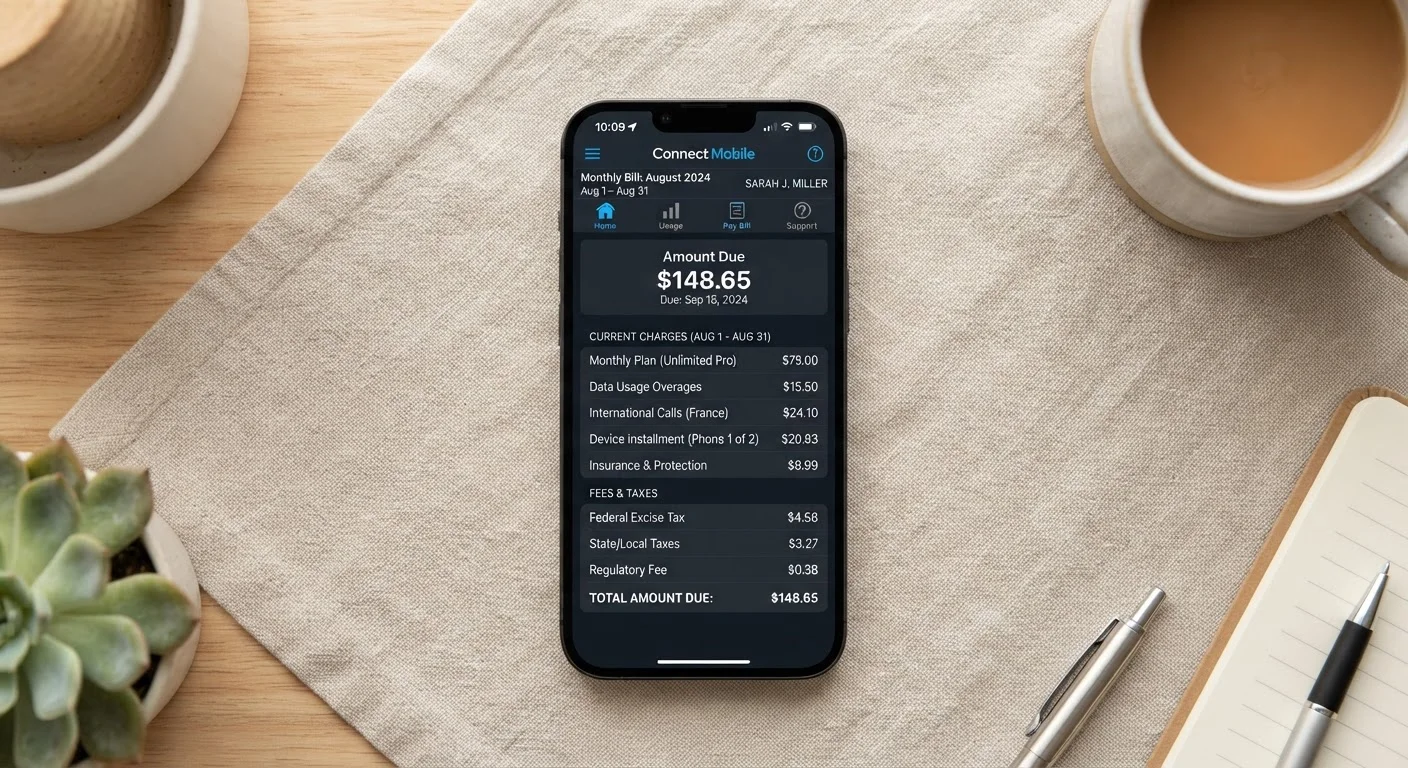
Why Your Bill Is Higher Than the Advertised Price
You signed up for a $45-a-month plan, but your first bill shows $58. This gap between advertised price and actual charge surprises many people — and it's not accidental. Carriers are required by law to collect certain government-mandated fees, and many add their own administrative charges on top. Understanding each line item puts you back in control.
Before diving in, it helps to know that your bill typically falls into three buckets: your base plan charge, government-mandated taxes and fees, and carrier-assessed surcharges. The first is what was advertised. The second and third are what inflate the total. See our plain-English guide to mobile plans if you're still deciding on a plan type.
| Typical fee inflation above advertised price | 20–30% higher in many US markets (General industry range; varies by state and carrier) |
| Who sets government taxes | Federal, state, and local governments |
| Who sets carrier surcharges | The carrier itself |
| USF program administrator | Federal Communications Commission (FCC) |
| Device installment included in plan price | No — billed as a separate line |
| Can government taxes be negotiated away | No — they are legally mandated |
Government Taxes and Mandated Fees — Line by Line
These charges are set by federal, state, or local authorities. Carriers collect them and pass them directly to the government. You cannot negotiate them away, but understanding what each one funds helps.
- Federal Universal Service Fund (USF) contribution: Funds programs that bring phone and broadband service to rural areas, low-income households, schools, and libraries. The rate is set quarterly by the FCC.
- State and local sales or use tax: Applied to your monthly service, just like sales tax on any other purchase. Rates vary significantly by state and even by municipality.
- State 911 surcharge: A per-line fee that funds your local emergency dispatch infrastructure. Some states charge this monthly per line; others charge it differently.
- Regulatory recovery fee (government-labeled): Covers costs of complying with FCC regulations and other federal obligations. Though it sounds like a government fee, carriers sometimes set the exact amount themselves.
For a deeper look at terminology that appears in billing statements, see mobile plan terms every American should understand.
Base plan charge
The advertised monthly cost for your voice, text, and data service. This does not include taxes, government fees, or carrier surcharges.
Universal Service Fund (USF)
A federal program administered by the FCC that subsidizes phone and broadband access for underserved communities, schools, and libraries. Carriers collect contributions from subscribers.
Administrative charge
A fee set by the carrier — not the government — to cover internal operating costs. It is not a government-mandated tax, even though it may appear alongside them.
Device installment plan
An arrangement where the cost of a smartphone is split into monthly payments over a set term (commonly 24 or 36 months), billed separately from your service plan.
Regulatory recovery fee
A carrier-set surcharge framed around the cost of complying with government regulations. Unlike true government fees, the carrier has discretion over the amount charged.
Overage charge
A per-unit fee applied when you exceed the data, voice, or text limits included in your plan. Common on tiered or limited plans; rare on true unlimited plans.
Carrier Surcharges — What They Are and Who Sets Them
Unlike government taxes, carrier surcharges are fees the carrier sets and keeps — or at least has discretion over. They're often named to sound governmental, which causes confusion.
- Administrative charge: A fee carriers assess to cover internal costs like billing, customer service, and network maintenance. The FCC does not mandate this; the carrier sets the amount.
- Regulatory programs fee / regulatory charge: Similar to administrative charges, this is a carrier-set fee framed around regulatory compliance. Not a government tax.
- Network access charge: Covers your connection to the carrier's network infrastructure. Sometimes bundled, sometimes listed separately depending on the carrier.
- Telecom relay service (TRS) surcharge: Funds services for people with hearing or speech disabilities, as required by the FCC, but the exact line-item amount can vary by carrier.
- Device installment plan charge: If you're paying off a phone on a monthly installment agreement rather than buying it outright, this line appears separately from your service plan. It is not included in advertised plan prices.
Carrier Fees Are Not Government Taxes
Administrative charges, regulatory recovery fees, and network access charges are set by the carrier — not mandated by any government agency. Their names can make them sound official, but they are not taxes. If you're comparing plans, ask carriers to provide a total estimated monthly cost including all surcharges, not just the base plan price.
Carrier surcharges are a common source of bill shock. Common assumptions about mobile plans that cost people money covers other areas where people are frequently caught off guard.
One-Time and Variable Charges Worth Watching
Beyond recurring monthly items, some charges appear only occasionally — and can significantly increase a single bill if you're not watching.
- Activation or SIM card fee: A one-time charge when you start a new line. Some carriers waive this; others do not.
- Upgrade fee: Charged when you upgrade a device through the carrier, separate from the device cost itself.
- International roaming charges: If you used data, called, or texted internationally without a travel add-on, these can be substantial. Always review before traveling.
- Overage charges (on limited plans): If your plan caps data, calls, or texts, exceeding those limits triggers per-unit charges. Unlimited plans eliminate most overages, but not all — some cap hotspot data at high-speed, for example.
- Late payment fee: Applied if autopay fails or you miss a due date. Enrolling in autopay also sometimes qualifies you for a plan discount — check your agreement.
Before committing to any plan, use our pre-signup checklist to verify exactly what fees apply. And if your bill ever seems higher than it should be relative to what you're getting, paying more doesn't always mean better service explains why.
20–30%
Average fee inflation above advertised plan price
Taxes and carrier surcharges routinely add this margin on top of the base rate quoted in advertising, with variation by state.
50+
States and territories with distinct 911 surcharge structures
Every US state and many local jurisdictions set their own 911 fee rates, contributing to wide variation in monthly bills for identical plans.
The content on this site is for informational purposes only and is not a substitute for professional advice. Always consult a qualified professional for guidance specific to your situation.