

Why Fitness Jargon Feels Like a Foreign Language
Walk into any gym, open a fitness app, or scroll through a workout video, and you'll run into words that sound vaguely scientific or needlessly technical. "Drop sets." "Lactate threshold." "Progressive overload." For beginners, this language can feel like a barrier - as if you need a personal trainer just to decode the instructions.
You don't. Most fitness terms have straightforward meanings once someone takes a second to explain them. This glossary does exactly that. Think of it as your quick-reference guide for the words that show up most often, explained the way a knowledgeable friend would explain them - not a textbook.
If you find nutrition language equally puzzling, the practical glossary of everyday nutrition terms covers that side of the wellness vocabulary just as plainly.
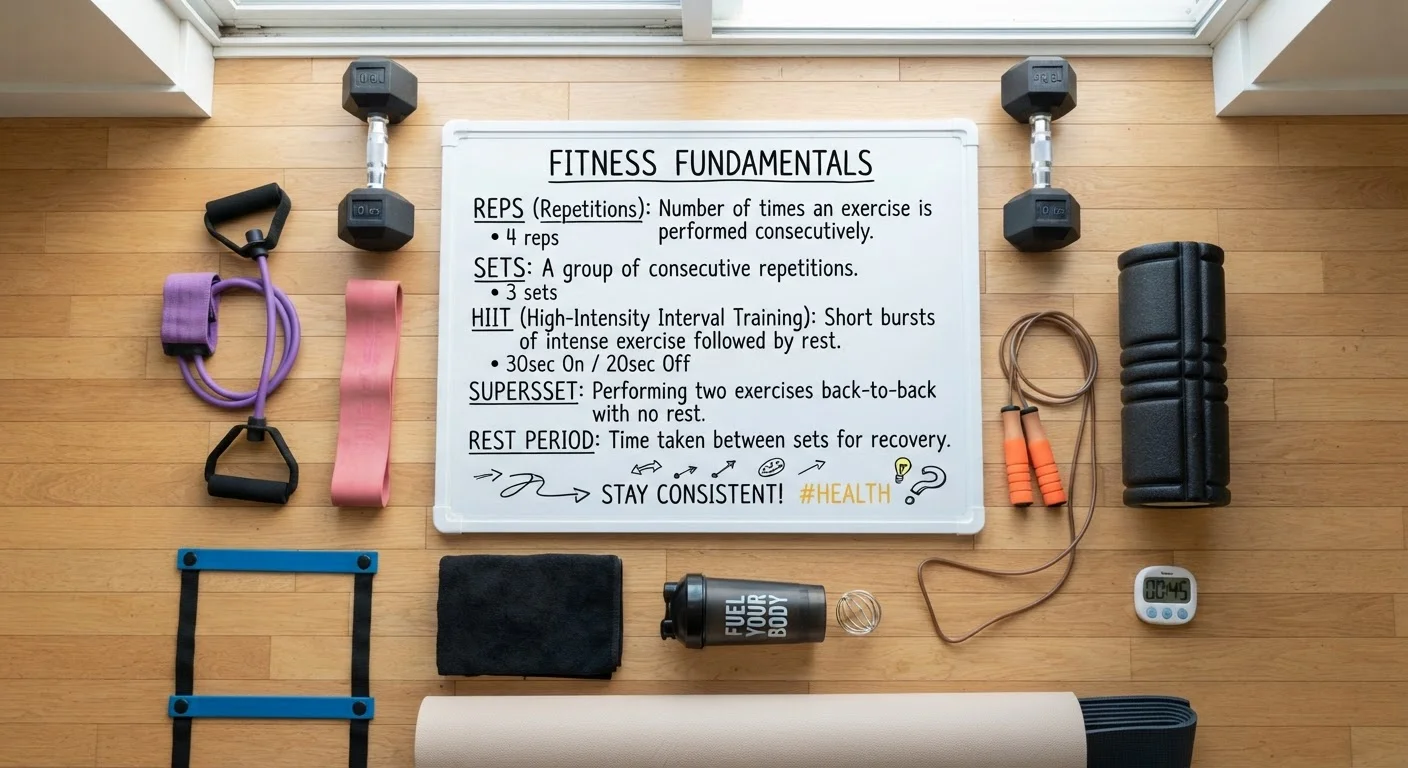
Reps (Repetitions)
One complete movement of an exercise - for example, lowering and raising a dumbbell once counts as one rep. Reps are the basic building block of any strength workout.
Sets
A group of reps performed consecutively before resting. If you do 10 reps, rest, then do 10 more, you've completed two sets of 10.
HIIT
High-Intensity Interval Training. A workout style that alternates short bursts of hard effort with brief recovery periods. HIIT sessions are typically short but physically demanding.
VO2 Max
The maximum rate at which your body can use oxygen during intense exercise. It's a measure of cardiovascular fitness - a higher number generally reflects a more efficient heart and lungs.
Rest Interval
The amount of time you pause between sets or exercises. Shorter rest periods keep your heart rate elevated; longer periods allow greater muscle recovery between heavy lifts.
Compound Exercise
A movement that engages multiple muscle groups at once, such as a squat, deadlift, or push-up. Compound exercises are time-efficient and build functional strength.
Isolation Exercise
A movement that targets one specific muscle group, such as a bicep curl. These are often used to address weak points or for rehabilitation purposes.
RPE (Rate of Perceived Exertion)
A self-reported scale - typically 1 to 10 - that describes how hard an effort feels. An RPE of 6 might feel moderately challenging; an RPE of 9 feels nearly maximal.
Drop Set
A technique where you complete a set to near-failure, immediately reduce the weight, and continue without resting. It's used to increase training volume and fatigue the muscle more thoroughly.
DOMS
Delayed Onset Muscle Soreness. The aching or stiffness that typically appears 24-48 hours after unfamiliar or intense exercise. It's normal, especially for beginners, and usually fades within a few days.
Active Recovery
Low-intensity movement on rest days - such as walking, gentle stretching, or yoga - intended to promote blood flow and reduce soreness without adding significant training stress.
1RM (One-Rep Max)
The maximum amount of weight you can lift for exactly one rep of a given exercise. It's commonly used as a reference point for setting training loads, though beginners typically estimate it rather than test it directly.
Key Concepts You'll Encounter in Workouts
Beyond individual word definitions, it helps to understand how some of these terms work together in practice.
| Recommended weekly cardio (moderate intensity) | At least 150 minutes (U.S. Department of Health and Human Services Physical Activity Guidelines) |
| Recommended weekly strength sessions | 2 or more days (U.S. Department of Health and Human Services Physical Activity Guidelines) |
| Typical HIIT session length | 15-30 minutes (General fitness practice; varies by protocol) |
| DOMS peak onset | 24-48 hours post-exercise (American College of Sports Medicine) |
| Rest between heavy strength sets | 2-5 minutes (National Strength and Conditioning Association general guidance) |
Volume, Intensity, and Frequency
These three words describe the shape of any workout plan. Volume is the total amount of work (total reps multiplied by sets multiplied by weight). Intensity describes how hard each effort is - often expressed as a percentage of your maximum capacity. Frequency is simply how often you train a particular muscle group or movement pattern each week. Coaches balance all three to match a person's goals and recovery ability.
Cardio vs. Resistance Training
Cardiovascular exercise (often shortened to cardio) raises your heart rate and challenges your heart and lungs - running, cycling, swimming, and brisk walking all count. Resistance training (also called strength training or weight training) uses external load or bodyweight to create muscular effort. Both forms of exercise contribute to overall health, and most guidelines suggest including both in a well-rounded routine. Always consult a healthcare professional before starting a new exercise program, especially if you have an existing health condition.
Progressive Overload
This is arguably the most important concept in fitness. Progressive overload simply means gradually increasing the demand on your body over time - lifting slightly heavier, doing one more rep, or reducing rest time. Without it, your body adapts and stops changing. With it, you continue building strength or endurance safely. The key word is gradually - rushing overload is a common cause of injury for beginners.
Once you feel comfortable with the language, the next step is putting it into practice consistently. The guide to building a sustainable fitness habit walks through how to do exactly that without burning out.
This article is for general informational purposes only and is not a substitute for professional medical or fitness advice. Consult a qualified healthcare provider before beginning any new exercise program.
The content on this site is for informational purposes only and is not a substitute for professional advice. Always consult a qualified professional for guidance specific to your situation.