

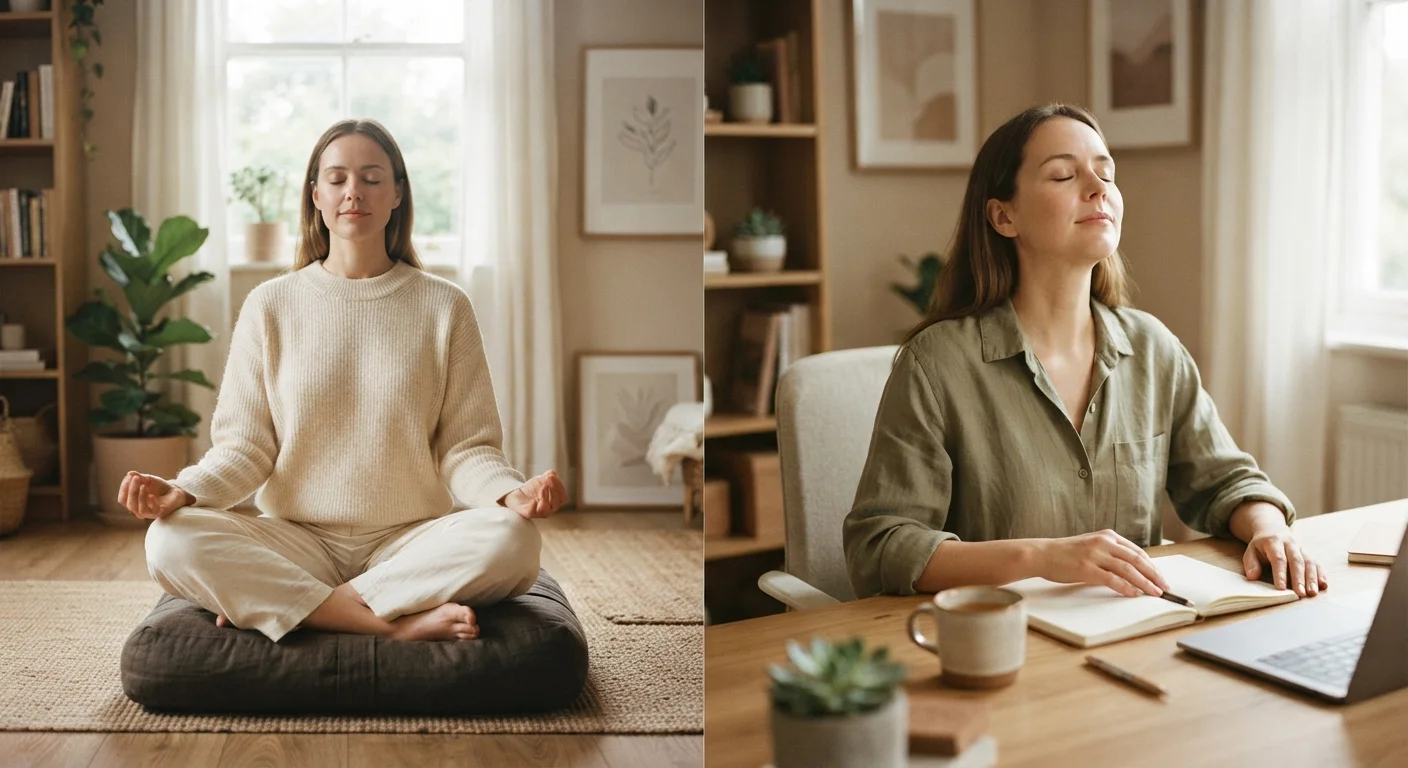
Option A
Meditation
The sustained, mind-training practice.
Best for: People who want to build long-term emotional resilience and a quieter mental baseline over weeks and months.
Option B
Deep Breathing
The fast, portable stress reset.
Best for: Anyone who needs quick, in-the-moment relief from stress, anxiety, or physical tension - no learning curve required.
How Each Practice Actually Works
Despite often being lumped together, meditation and deep breathing operate through distinct mechanisms - and knowing the difference helps you choose the right tool for the moment.
Meditation is an umbrella term for practices that train attention and awareness. Most beginner-friendly forms - like focused attention or body scan meditation - ask you to anchor your mind on a single point (the breath, a phrase, body sensations) and gently return whenever it wanders. Over time, this repetition is thought to strengthen the brain's ability to regulate emotion and interrupt automatic stress reactions. It typically takes weeks of consistent practice before those changes feel noticeable.
Deep breathing works faster because it directly manipulates the nervous system. When you breathe slowly and deliberately - typically extending your exhale longer than your inhale - you stimulate the vagus nerve, which signals the parasympathetic ("rest and digest") system to slow your heart rate and ease muscle tension. You don't need to clear your mind or sit in silence. The physical act alone does the work.
If you're exploring where either of these fits into a broader wellness approach, this starting-point guide for mental wellness offers a calm overview of the fundamentals.
A Side-by-Side Look at What the Evidence Says
Both practices have a genuine evidence base - but the depth of research and the types of benefits studied differ in important ways.
| Criterion | Meditation | Deep Breathing |
|---|---|---|
| Time to first benefit | Weeks of regular practice | Within minutes |
| Session length | Typically 10-20 min/day | 2-5 minutes as needed |
| Learning curve | Moderate - takes guidance and patience | Minimal - simple patterns to follow |
| Best use case | Long-term emotional resilience | Immediate stress or anxiety relief |
| Equipment or app needed | Optional but helpful | None |
| Can be done anywhere | Mostly - needs quiet focus | Yes - discreet and portable |
| Sleep quality support | Strong evidence for regular practitioners | Helpful as a pre-sleep wind-down |
Meditation has been studied most extensively for its effects on anxiety, depression symptoms, and chronic pain. A widely cited review published in JAMA Internal Medicine found mindfulness meditation programs produced moderate improvements in anxiety, depression, and pain - though researchers noted the evidence base was stronger in some populations than others. Gains tend to compound: people who practice for months typically report more meaningful changes than those who try it for a few days.
Deep breathing research tends to focus on acute (immediate) effects: heart rate variability, cortisol levels, and self-reported tension. Evidence consistently supports its usefulness as a rapid calming tool. Some studies on diaphragmatic breathing have found reductions in cortisol after just a few minutes of practice, though sample sizes are often small.
This article is for general informational purposes and is not a substitute for professional medical or mental health advice. If you're experiencing significant anxiety or mood disturbances, please consult a qualified healthcare provider.
Time, Effort, and Everyday Fit
Realistically, the practice you'll actually do is the one that wins.
Meditation asks more upfront. Most guidance recommends starting with 10-20 minutes daily, ideally at a consistent time. Early sessions can feel frustrating - the mind wanders constantly, and that's normal - but many people find the initial awkwardness fades within two to three weeks. Apps, audio guides, and simple timer-based approaches can all lower the barrier.
Deep breathing is genuinely frictionless. A 4-7-8 breath (inhale for four counts, hold for seven, exhale for eight) or simple box breathing (equal counts in, hold, out, hold) can be done discreetly at a desk, in a car, or before a difficult conversation. There is nothing to learn beyond the basic pattern.
For people building an evening wind-down, both practices slot in naturally. This guide to quieting your mind before bed walks through how to build a routine around them. And for those wanting to layer these tools alongside other mood-supporting habits, small daily habits for a steadier mood offers practical options that don't require big lifestyle changes.
~8 weeks
Typical timeframe for measurable meditation benefits
Many well-designed studies use 8-week structured mindfulness programs (such as MBSR) as their benchmark intervention period.
< 2 min
Time for deep breathing to begin slowing heart rate
Research on slow-paced breathing (around 6 breath cycles per minute) shows heart rate variability changes can occur rapidly.
~40%
Reduction in perceived stress reported in some mindfulness studies
Reductions vary across studies and populations; individual results depend on consistency, baseline stress, and program type.
The content on this site is for informational purposes only and is not a substitute for professional advice. Always consult a qualified professional for guidance specific to your situation.