

Our Verdict
Animal proteins offer completeness and high digestibility with less planning, while plant proteins bring fiber, cost savings, and broader environmental advantages. Neither category is universally better - the strongest eating patterns in research tend to include a thoughtful mix of both.
| Best for | Recommended |
|---|---|
| Those who want high protein quality with minimal meal planning | Animal proteins (eggs, chicken, dairy) |
| Those following a vegetarian or vegan lifestyle | Varied plant proteins (legumes, soy, grains) |
| Budget-conscious eaters prioritizing volume and fiber | Legumes and whole grains |
| Most people who want flexibility without complicated rules | A mix of both animal and plant sources |
What Makes a Protein 'Good'?
Protein quality comes down to two things: amino acid completeness and digestibility. Your body needs nine essential amino acids it can't make on its own - it has to get them from food. A protein source that delivers all nine in adequate amounts is called a complete protein. One that falls short in one or more is called incomplete.
Digestibility refers to how much of the protein your body actually absorbs and uses. Scientists measure this using a score called DIAAS, which accounts for both amino acid content and how well the gut absorbs it. Higher scores generally mean more usable protein per gram eaten. For a deeper look at what completeness and digestibility mean in practice, see our comparison of plant and animal protein completeness.
Animal Proteins: Eggs, Meat, Dairy, and Fish
Animal-based foods - eggs, poultry, red meat, fish, milk, yogurt, and cheese - are all complete proteins. Eggs in particular score near the top on digestibility measures and have long been used as a reference standard in protein research.
Dairy proteins (whey and casein) are also highly digestible and supply a solid amino acid profile. Greek yogurt and cottage cheese are practical, ready-to-eat options. Fish and poultry offer lean protein with relatively low saturated fat. Red meat delivers protein alongside iron and B12, though nutrition guidance generally suggests moderating portions of processed and fatty red meats.
The trade-offs: animal proteins tend to cost more per meal, require refrigeration, and come with environmental considerations around land and water use. They also lack fiber entirely.
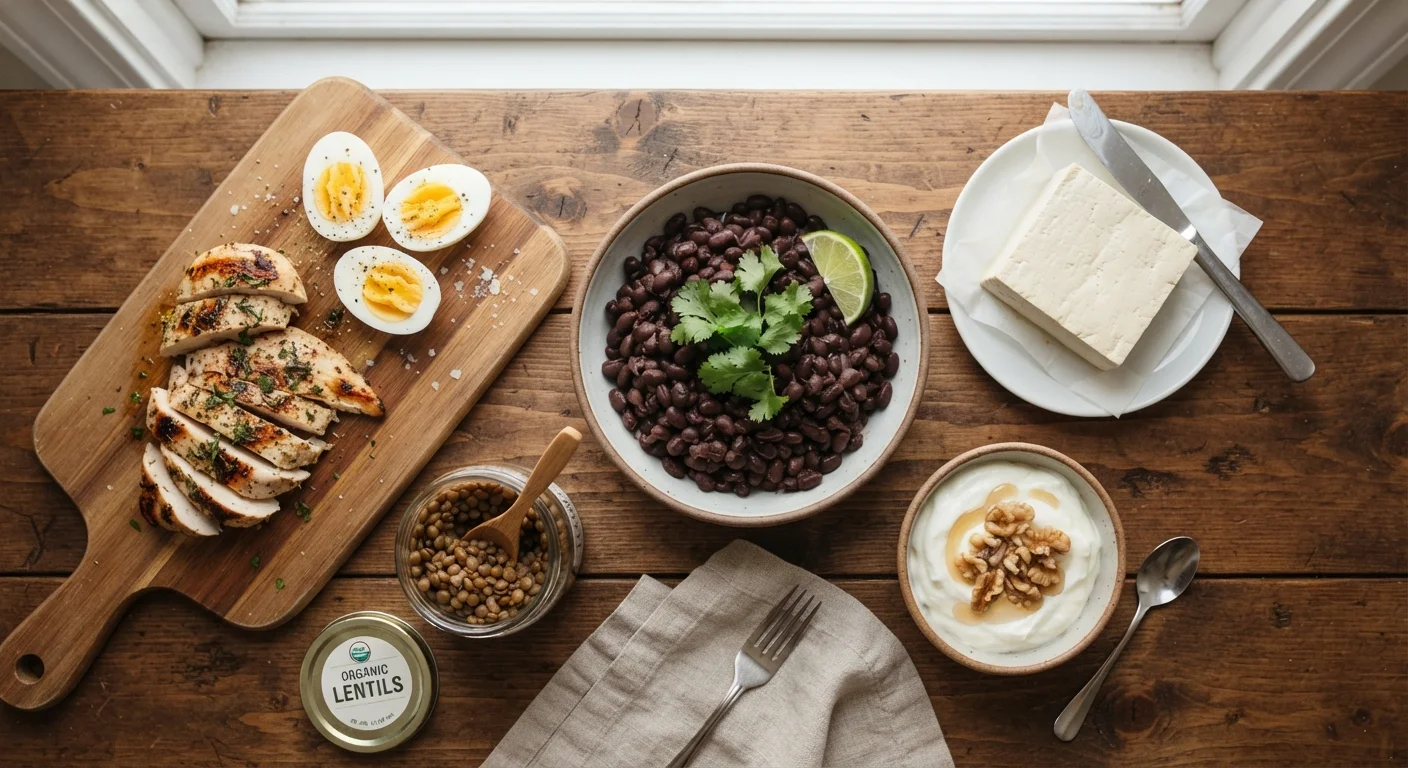
| Eggs | Chicken Breast | Greek Yogurt | Lentils | Tofu | Canned Beans | |
|---|---|---|---|---|---|---|
| Complete protein? | Yes | Yes | Yes | No (low methionine) | Yes | No (low methionine) |
| Digestibility | Very high | High | Very high | Moderate | Moderate-high | Moderate |
| Contains fiber? | No | No | No | Yes | Small amount | Yes |
| Approximate cost | Low | Moderate | Moderate | Very low | Low-moderate | Very low |
| Prep effort | Minimal | Moderate | Ready to eat | Low (canned) | Low-moderate | Ready to eat |
| Environmental footprint | Low-moderate | Moderate | Moderate | Very low | Low | Very low |
Plant Proteins: Legumes, Soy, Grains, and Nuts
Beans, lentils, chickpeas, tofu, tempeh, edamame, whole grains, and nuts all contribute meaningful protein. Soy stands out as the plant world's most complete protein - tofu, tempeh, and edamame supply all nine essential amino acids at levels comparable to many animal foods.
Other plant proteins have gaps. Most legumes are low in the amino acid methionine; most grains are low in lysine. But this doesn't mean plant eaters are at risk - eating a variety of plant foods across a day naturally fills those gaps. Rice and beans together, for instance, form a complementary amino acid profile without requiring any precise timing or planning.
Plant proteins also bring fiber, which supports digestive health and satiety - something animal proteins don't provide. They're generally more affordable and have a lower environmental footprint. Digestibility is somewhat lower on average than animal proteins, though fermented soy foods like tempeh and well-cooked legumes are reasonably well absorbed. To see how all of this fits into broader eating habits, research on major dietary patterns offers useful context.
Practical Trade-Offs Worth Knowing
For most people, the best protein strategy isn't picking a side - it's understanding the practical strengths of each source and building meals accordingly.
You Don't Need to Eat Meat at Every Meal
Protein needs can realistically be met across a full day, not just at a single sitting. Spreading protein across breakfast, lunch, dinner, and snacks - using a mix of sources - is a practical approach that suits most eating styles. There's no need to calculate grams obsessively; focusing on including a protein-rich food at each meal is usually enough for healthy adults.
- Eggs and Greek yogurt are among the easiest high-quality proteins to prepare quickly.
- Canned beans and lentils require almost no cooking and cost very little per serving.
- Tofu and tempeh absorb flavors readily and work well in a wide range of cuisines.
- Fatty fish (salmon, sardines, mackerel) adds omega-3 fatty acids alongside protein.
- Nuts and seeds are portable and convenient but are calorie-dense, so portion size matters.
Variety remains the most durable principle. People following omnivore, vegetarian, and vegan diets can all meet protein needs - the more restrictive the diet, the more deliberate the food choices need to be. For a low-pressure way to apply this kind of variety day-to-day, see our guide on building a varied plate without overthinking it.
This article is for general informational purposes only and is not a substitute for personalized nutrition or medical advice. Consult a registered dietitian or qualified healthcare provider for guidance specific to your health needs.
The content on this site is for informational purposes only and is not a substitute for professional advice. Always consult a qualified professional for guidance specific to your situation.