

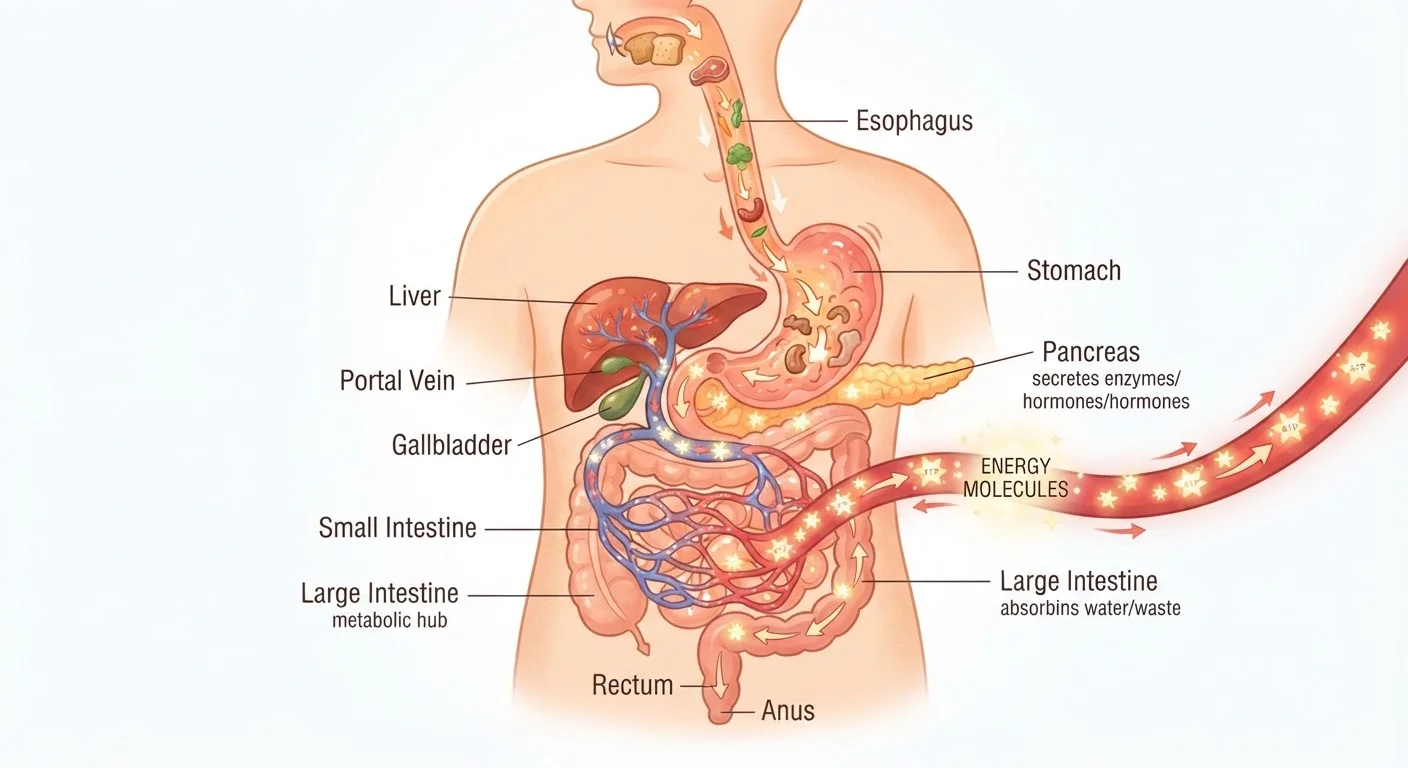
From Fork to Fuel: What Happens After You Eat
The moment food enters your body, a finely coordinated process begins. Carbohydrates are the fastest-acting fuel source - enzymes in your saliva and small intestine break them down into glucose, which moves into the bloodstream relatively quickly. Proteins and fats follow slower, more complex pathways before contributing usable energy.
Once glucose enters the blood, the pancreas releases insulin. Think of insulin as a logistics manager: it directs glucose toward cells that need immediate fuel (like working muscles and the brain), and routes the rest into storage. This is the fundamental rhythm of energy management - intake, distribution, and reserve.
To understand what carbohydrates, proteins, and fats each contribute to this process, see our explainer on what macronutrients actually do inside your body.
The Two-Tier Storage System: Glycogen and Fat
Your body keeps energy in two main forms, each suited to different timescales.
Glycogen is the short-term store. Glucose that isn't immediately used gets packaged into glycogen and tucked away in your liver and muscle tissue. Liver glycogen helps maintain stable blood sugar between meals. Muscle glycogen is reserved mostly for movement - it's drawn on during exercise and physical activity.
The catch: glycogen storage is limited. Once those tanks are full, surplus glucose gets converted and stored as body fat - the long-term reserve. Fat stores are far more energy-dense and essentially unlimited in capacity, making them the body's preferred option for riding out extended periods without food.
~400g
Approximate total glycogen capacity in adults
Most adults can store roughly 300-500 grams of glycogen across liver and muscle tissue, representing a relatively modest short-term energy reserve.
~4 kcal/g
Energy yield from carbohydrates and protein
Both carbohydrates and protein yield approximately 4 kilocalories per gram; dietary fat yields around 9 kcal/g, making it the most energy-dense macronutrient.
15-30 min
Time for simple carbs to reach bloodstream
Simple carbohydrates can begin raising blood glucose within 15-30 minutes of eating, compared to complex carbs, proteins, and fats which take considerably longer.
This two-tier system evolved to handle unpredictable food availability. Today, with consistent access to food, most people's bodies rarely deplete glycogen stores entirely - but the storage mechanism works the same way regardless.
Releasing Energy: How the Body Taps Its Reserves
Between meals or during exercise, blood glucose begins to drop. The pancreas responds by releasing glucagon - essentially the opposite of insulin. Glucagon signals the liver to break glycogen back down into glucose and release it into the bloodstream, keeping fuel available to cells.
During sustained or intense physical activity, muscles also draw directly on their own glycogen stores. When those run low, the body increasingly turns to fat - breaking it down through a process called lipolysis into fatty acids and glycerol, which can be used as fuel. This shift doesn't happen instantly; it's a gradual adjustment based on duration and intensity of demand.
Movement habits that support energy levels through the day offer a practical look at how activity influences this release process in everyday life.
Energy Management While You Sleep and Fast
Energy management doesn't pause when you do. During sleep, your body continues drawing on glycogen - particularly liver glycogen - to fuel the brain and maintain essential functions. By morning, liver glycogen is often partially or significantly depleted, which is why a morning meal can feel restorative.
Longer gaps without eating extend this picture. After several hours, once readily available glycogen is running low, the body leans more heavily on fat stores. Hormones like cortisol and growth hormone - both of which tend to rise during sleep - also play a role in mobilising stored energy overnight.
It's worth noting that water plays an underappreciated role in how efficiently this all works. See how hydration affects the way your body uses food for more on that connection.
This article is for general informational and educational purposes only and is not medical or nutritional advice. For questions about your individual health, consult a qualified healthcare professional.
Frequently Asked Questions
Digestion begins within minutes of eating, and glucose starts entering the bloodstream within 15-30 minutes for simple carbohydrates. Proteins and fats take longer to break down, providing a more gradual energy release over several hours.
During sleep, the body draws on glycogen stores to maintain basic functions like breathing, temperature regulation, and brain activity. This is one reason blood sugar can be lower in the morning after a full night's fast.
Not strictly - the body uses a mix of fuel sources simultaneously. The proportion shifts depending on intensity of activity, how recently you ate, and how available each fuel source is at the time.
Glycogen capacity is relatively modest - roughly 300-500 grams total across muscles and the liver for most adults, equivalent to around 1,200-2,000 calories. Once those stores are full, excess energy is directed toward fat storage.
A natural dip in alertness occurs in the early afternoon due to circadian rhythm shifts and the body's post-meal metabolic response. It's a normal physiological pattern, not necessarily a sign of poor diet or inadequate sleep.
The content on this site is for informational purposes only and is not a substitute for professional advice. Always consult a qualified professional for guidance specific to your situation.