

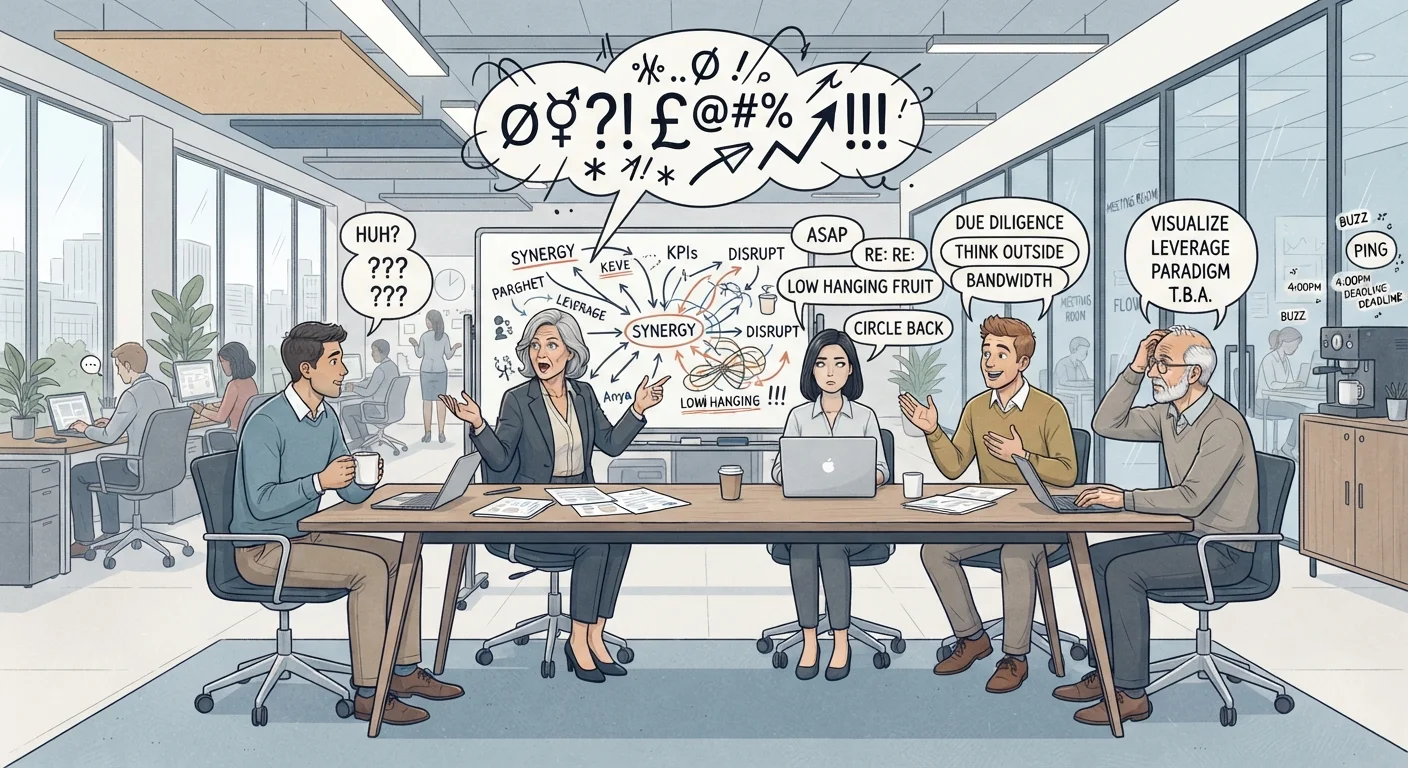
Why Workplace Language Gets So Cryptic
Every workplace develops its own dialect. Phrases like "let's take this offline" or "we need more bandwidth" get repeated so often they stop meaning much of anything - yet everyone nods along. That shared performance of understanding can leave newer employees or people switching industries genuinely confused about what's being asked of them.
Corporate jargon isn't inherently bad. Shorthand speeds up communication when everyone shares the same reference points. The problem is when phrases substitute for actual clarity - masking vague requests, uncomfortable truths, or decisions that haven't been made yet. Learning to decode the language around you is a real workplace skill, and it connects directly to how office culture actually works on a deeper level.
This reference guide covers the phrases you're most likely to encounter, what they typically signal, and how to respond without getting lost in translation.
Common Phrases, Decoded
Circle back
To return to a topic or conversation at a later time. In practice, it often signals that a decision or answer is being deferred without a firm timeline.
Bandwidth
Borrowed from tech, this refers to a person's available time and mental capacity. "I don't have the bandwidth" means someone is too busy or stretched too thin to take on more.
Move the needle
To make a meaningful, measurable impact on a metric or goal. If an idea "doesn't move the needle," it's seen as too small to matter in the current context.
Take offline
To continue a conversation outside the current meeting or group setting - usually because the topic is too detailed, sensitive, or specific to be useful for everyone present.
Low-hanging fruit
Tasks or opportunities that require minimal effort but deliver relatively quick results. Often used to prioritise early wins in a project.
Boil the ocean
To attempt something unnecessarily complex or all-encompassing. Saying a plan "boils the ocean" means it's too ambitious in scope given the resources or time available.
Deep dive
A thorough, detailed examination of a topic or problem. Being asked to "do a deep dive" means leadership wants comprehensive analysis, not a summary.
Ping
To send a quick message or notification to someone. Derived from network terminology, it's now used casually to mean any brief outreach - "I'll ping you later."
The glossary above covers the big ones, but a few phrases deserve extra context:
"Let's circle back"
Usually means: I don't have an answer right now or this isn't a priority at the moment. When someone says this to you, it's worth following up in writing to get a concrete timeline - otherwise "circling back" can mean never.
"We need to be more strategic"
Often a placeholder for unstated priorities. If a manager uses this phrase, ask a direct follow-up: "What outcomes are we optimising for?" It forces the conversation from vague to actionable.
"That's not in scope"
Means the task, idea, or request falls outside what the current project is designed to deliver. This is often a reasonable and useful boundary - but it can also be used to avoid work without explanation. If it affects you, ask where it would fit.
"We're doing more with less"
Typically signals a budget cut, headcount reduction, or both. It's often said to frame resource constraints as an opportunity. Take it as a cue to clarify your priorities - you can't do everything well when resources shrink. See also: how to set workload boundaries clearly.
"Synergy" and "alignment"
"Synergy" describes two teams or efforts producing better results together than separately - a real concept, though frequently overused. "Alignment" usually means everyone agrees on the direction or decision. When someone asks for alignment, they're often asking: are we all on the same page, and if not, why not?
When Jargon Signals Something Bigger
Sometimes the language people use at work reveals more than the words themselves. Heavy use of vague phrases - "we're exploring options," "leadership is evaluating the situation" - can be a sign that decisions are being made above your level and haven't been communicated yet. That's worth noting, not panicking over.
Jargon also does a different kind of work: it can create in-group and out-group dynamics. Colleagues who are fluent in the current vocabulary of a workplace often hold more social capital - not because their ideas are better, but because their communication style matches the environment. This is one of the career myths worth examining - the idea that hard work alone determines who gets heard.
If you find workplace communication chronically unclear, the issue may go beyond individual phrases. Choosing the right communication format - when to message versus when to meet - can significantly reduce the confusion that jargon tends to paper over.
When in doubt, ask a clarifying question. "Can you say more about what that looks like in practice?" is a professionally neutral way to surface the concrete meaning behind almost any corporate phrase.
The content on this site is for informational purposes only and is not a substitute for professional advice. Always consult a qualified professional for guidance specific to your situation.